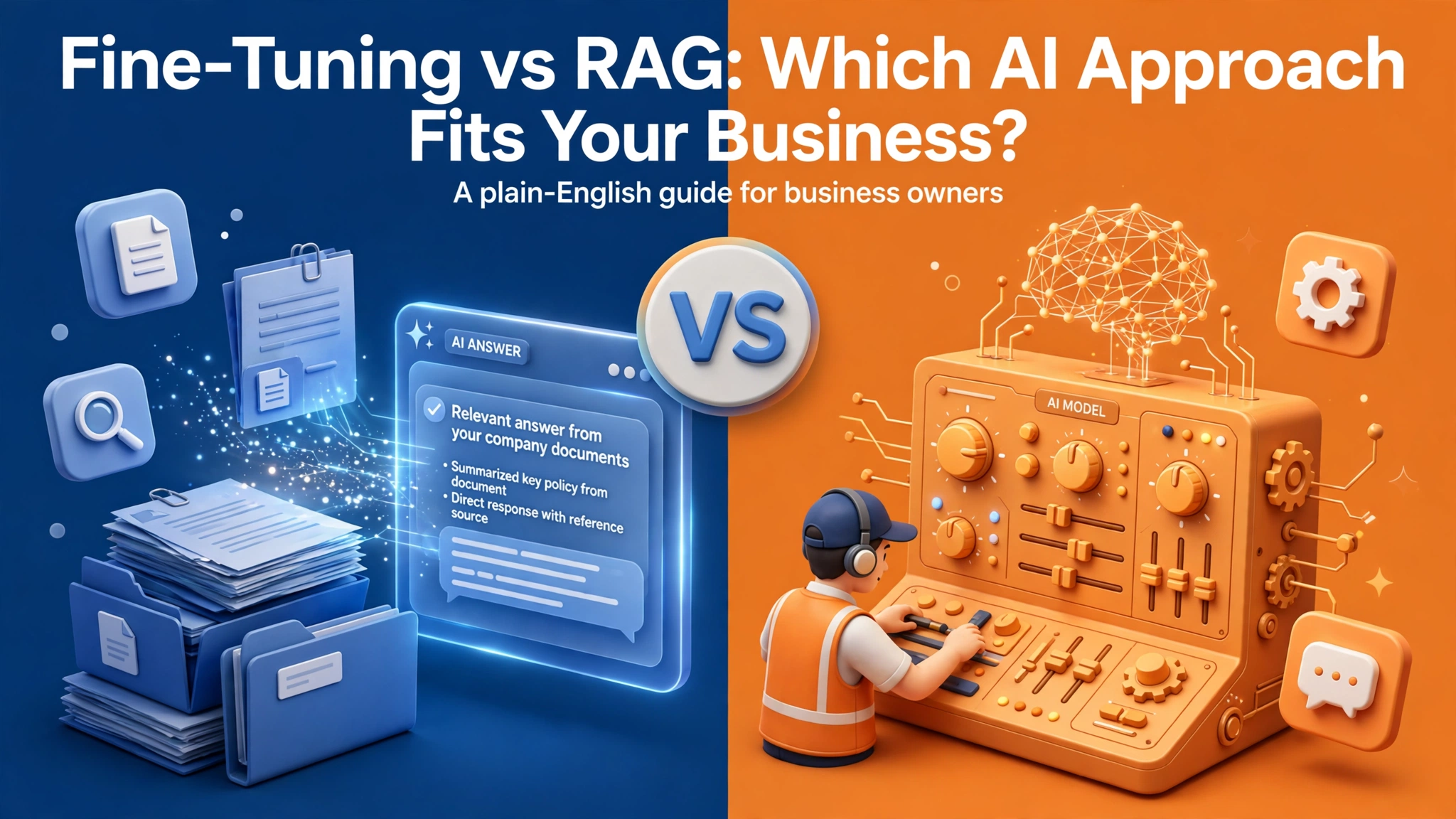
Fine-Tuning vs RAG: Which AI Approach Fits Your Business?
Fine-tuning vs RAG explained for business owners: what each AI approach costs, when each wins, and how to pick the right one for your product.
 Talha Javed7 min read
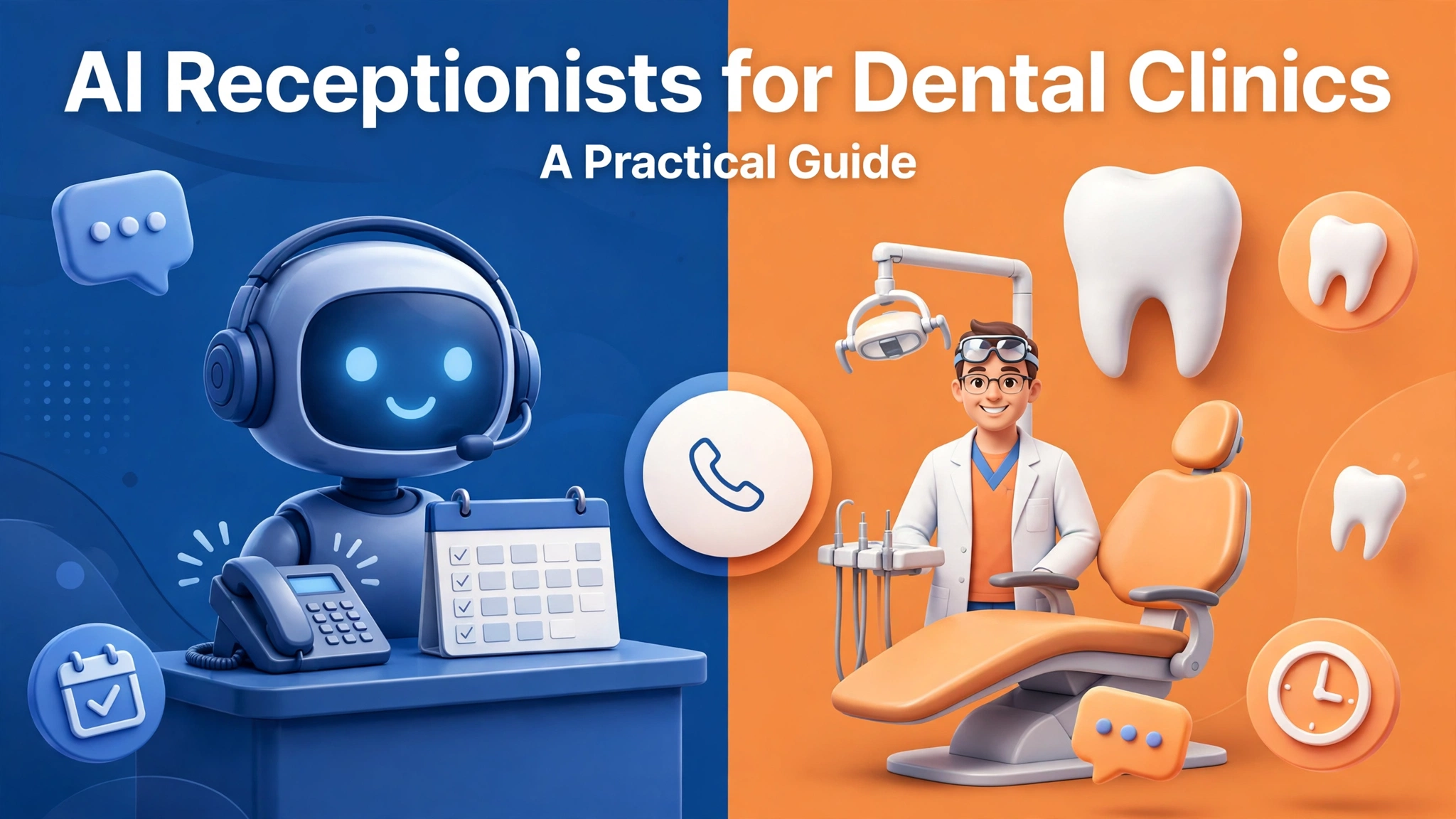
Your front desk rings, and nobody picks up. The receptionist is with a patient, on another call, or at lunch. The caller hangs up and rings the next clinic on Google. That is the call an AI receptionist is built to answer.
An AI receptionist for a dental clinic is a voice assistant that answers your phone, books appointments into your diary, handles cancellations and takes messages when a human is needed. It works outside opening hours, on weekends, and during the lunch break.
Most of the calls a dental clinic receives are routine. A patient wants to book a checkup, move an appointment, ask what time you close, or check whether you take new patients. These are simple conversations a voice assistant handles well.
A good AI receptionist does five things. It answers every call, even when all lines are busy. It books appointments directly into your practice diary, checking real availability. It reschedules and cancels, and it can offer the freed slot to the next patient on a waiting list. It answers common questions from your own information, such as opening hours and prices. And it hands over cleanly to a human when the call is not routine, for example when a patient is in pain, upset, or asking about a treatment plan.
The handover matters most. A patient in pain should never be stuck talking to a machine. The assistant should recognise urgency and get a human involved fast.
Our guide to AI booking assistants for clinics and salons covers the booking side, including reminders that cut no-shows.
Most clinic owners underestimate how many calls go unanswered. The front desk is one person, also greeting patients, taking payments, and sorting paperwork. When the phone rings while they are with a patient, the call goes to voicemail.
The expensive missed calls are the ones at 7 in the evening, when someone with a cracked tooth searches for a dentist and rings three clinics in a row. The first clinic that answers usually gets the patient. The same applies on Saturday morning and over a bank holiday weekend.
There is a quieter loss too. Existing patients ring to move an appointment and give up, so the slot stays blocked and the chair sits empty. An assistant that answers and reschedules turns that empty hour into a booked one.
An AI receptionist is strong on routine conversations with a clear outcome: booking, rescheduling, cancelling, confirming, answering price and opening hours questions, taking a message, and sending a reminder. A well built assistant handles these without a human in the loop.
It is not the right tool for everything. Treatment advice is the obvious line. An assistant can tell a patient what a scale and polish costs, but it should never diagnose a symptom or recommend a treatment. Complaints are another. A patient unhappy about a bill or a wait deserves a human, and the assistant should transfer them. Complex bookings need care too: an interpreter, a longer appointment, or a specific clinician should go to your team.
The assistant takes the routine calls off your team so your team has time for the calls that need a person. Clinics that treat it as a replacement for the front desk end up with unhappy patients. Clinics that use it as a first line of defence end up with a calmer front desk and fewer missed calls.
Check this part carefully. A booking assistant that cannot see your real diary is worse than no assistant at all. It will promise slots that are already taken, and your team will spend the morning untangling double bookings.
Before you buy, ask exactly how the assistant connects to your practice management software. Some systems have an open integration, and the assistant reads and writes appointments directly. Others need a calendar sync. A few older systems have no integration at all, and the assistant can only take a message. That is still useful, but it is not the same product.
Ask for a live demo with your own diary, not a generic demo with made up slots. Watch the assistant book, move, and cancel an appointment. Then ask what happens when two patients ring for the last slot at the same time, and when the diary connection fails. Only one should get the slot.
There is no single price, because the products vary so much. Some charge a monthly subscription, some charge per minute of call time, and some charge a setup fee plus a monthly fee. A simple assistant that only answers and takes messages costs less than one that books into your diary and sends reminders.
What matters is not the headline price but what is included. Ask whether setup and training are included or charged extra, whether the monthly fee covers unlimited calls or a set number of minutes, what reminders cost, whether transfers cost extra, how long the contract ties you in, and what happens to your data if you leave.
Our breakdown of AI chatbot development costs explains the same pricing patterns. Judge the price against one missed new patient a week, or one empty chair a day. For most clinics, a single recovered booking covers the monthly fee several times over, but do the sums with your own numbers, not a vendor’s sales slide.
Every clinic owner asks this, and the answer depends on how the assistant is built and introduced. Patients mind being tricked. They do not mind a clear, capable assistant that solves their problem in a minute.
Two things decide the experience. The voice should sound natural, speak at a normal pace, and handle interruptions gracefully. And honesty: the assistant should introduce itself as an assistant, not pretend to be a person. In our experience, patients accept this quickly when the booking works and the tone is polite.
The best test is to call it yourself, as a patient. Try to book, try to cancel, try to ask something awkward. If you feel frustrated, your patients will too. Ask for a trial with real calls, and listen to a sample before you decide. Language matters too. A clinic in Dubai or London serves patients who switch between English and another language mid-sentence.
A receptionist handles patient data, and an AI one is no exception. Names, phone numbers, and appointment details pass through the system on every call. Before you sign, ask where calls are recorded and stored, for how long, who can listen, and whether recordings train the vendor’s models.
Ask for a data processing agreement that covers your clinic’s obligations, whether GDPR in the UK and Europe or local data law. If the vendor cannot provide one, walk away. Patients should know the call may be recorded and be able to ask for a human at any point.
Do not switch everything on at once. Start with the hours your team cannot cover: evenings, weekends, and the lunch break. Let the assistant handle those calls for two or three weeks while your team watches the bookings it makes.
Then widen it. Let the assistant take overflow calls during busy hours, when all lines are engaged. Keep a human on the phones for the first call of the day and for anything urgent. After a month, look at the numbers: calls answered, bookings made, bookings that turned up, and calls that still needed a human. Then decide whether to keep it or walk away. A vendor that resists a trial or a phased rollout is telling you something about their confidence in the product.
No, and it should not try. It handles routine calls and bookings so your team can focus on patients in the clinic and the calls that need a human. Think of it as extra cover.
A well built assistant recognises urgent language, takes the details, and escalates immediately, by transferring the call or alerting your team. Check this in the demo before you buy. It is the most important test of all.
It depends on the software. Some systems have a direct integration, some need a calendar sync, and a few have no connection at all. Ask the vendor to show it working with your exact system.
A simple assistant that answers and takes messages can be live in days. One that books into your diary, uses your prices and opening hours, and handles reminders takes longer, typically a few weeks including testing. Test with real calls before you go live.
An AI receptionist earns its place when it answers the calls your team cannot, books into your real diary, and hands urgent patients to a human without delay. The clinics that get the most from it test it properly and keep a human close.
Book a free strategy call and we will walk through your clinic’s call flow with you and tell you honestly whether an AI receptionist is worth it for your practice. We reply within 24 hours.
More from the studio.
Fine-tuning vs RAG explained for business owners: what each AI approach costs, when each wins, and how to pick the right one for your product.
Talha Javed7 min readAI customer support can speed up replies without losing the human touch. Learn what to automate, what to keep human, and how to start.
Talha Javed7 min readAI lead qualification explained: how automated scoring, routing and follow-up sort real buyers from casual browsers, and what to set up first.
Talha Javed7 min readA free 30-minute call with a senior engineer. You leave with a plan and a price range, whether or not you hire us.