How Much Does AI Chatbot Development Cost in 2026?
If you are budgeting for an AI chatbot, you want a number — and you can have one, with a caveat. In our experience, AI chatbot development cost in 2026 typically falls into three bands: a simple FAQ or lead-capture bot costs a few thousand dollars; an AI chatbot trained on your own business data — the build most of our clients ask for — usually lands in the low-to-mid five figures; and an advanced assistant with bookings, integrations or voice typically reaches well into five figures. The spread is wide because “chatbot” covers everything from a glorified contact form to a system that holds real conversations across your website, WhatsApp and phone lines. This guide breaks down what sits behind each band, the cost drivers that move a quote up or down, and the ongoing costs most proposals quietly leave out.
The short answer: AI chatbot price ranges in 2026
Here is the honest version we give on discovery calls — almost every business chatbot fits into one of three tiers:
- Simple FAQ and lead-capture bots — a few thousand dollars, two to four weeks. Button-driven flows and canned answers to your most common questions.
- AI chatbots trained on your business — low-to-mid five figures, four to eight weeks. Understand natural language and answer from your own content and product data.
- Advanced assistants with integrations and voice — mid five figures and up, eight to sixteen weeks. Book appointments, sync your CRM, or hold spoken conversations.
Most businesses we speak to assume they need the third tier and actually need the second — and that difference is where most of the money goes.
Simple FAQ and lead-capture bots
These are the bots that answer “what are your opening hours?” and collect a name and phone number before handing the conversation to a human. They follow scripted paths: the visitor taps buttons, the bot replies with pre-written answers. There is no real AI involved, which keeps the build cheap and predictable — but the moment a visitor types something unexpected, a scripted bot guesses wrong or gives up. For a small business that just wants to stop missing enquiries overnight, that trade-off is often fine. Just know what you are buying: a smart form, not an assistant.
AI chatbots trained on your business data
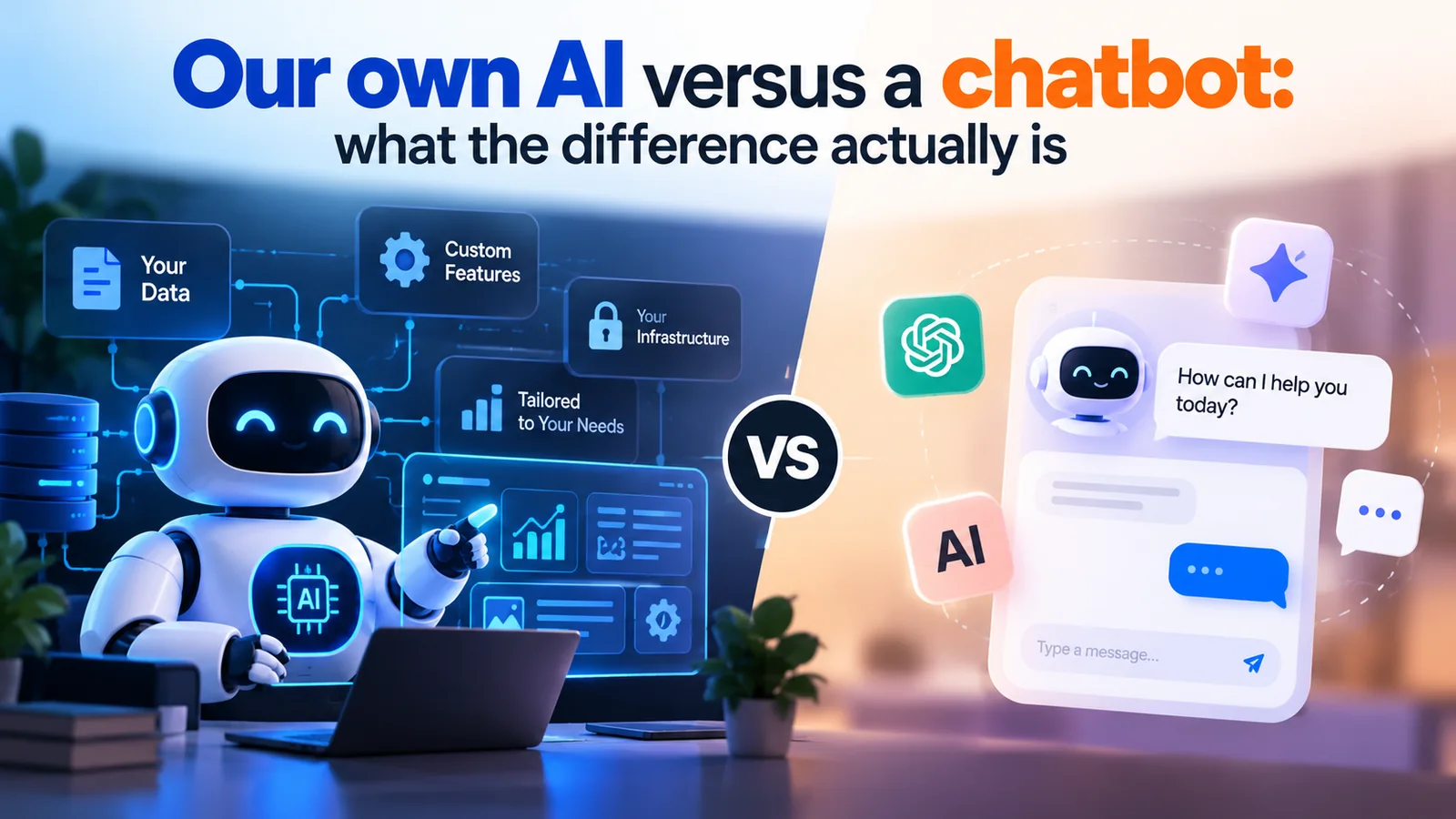
This is the sweet spot for most companies. The chatbot understands free-typed questions, searches your own knowledge base — service pages, FAQs, policy documents, product catalogues — and answers in its own words instead of inventing facts. Getting this right is real engineering work: your content has to be gathered, cleaned and structured, and guardrails have to stop the bot hallucinating when it does not know something. In our experience, the knowledge-base work is the part clients underestimate most. A bot trained on a tidy help centre behaves completely differently from one pointed at a pile of PDFs — and the former costs more because someone has to do the organising.
Advanced assistants and voice agents
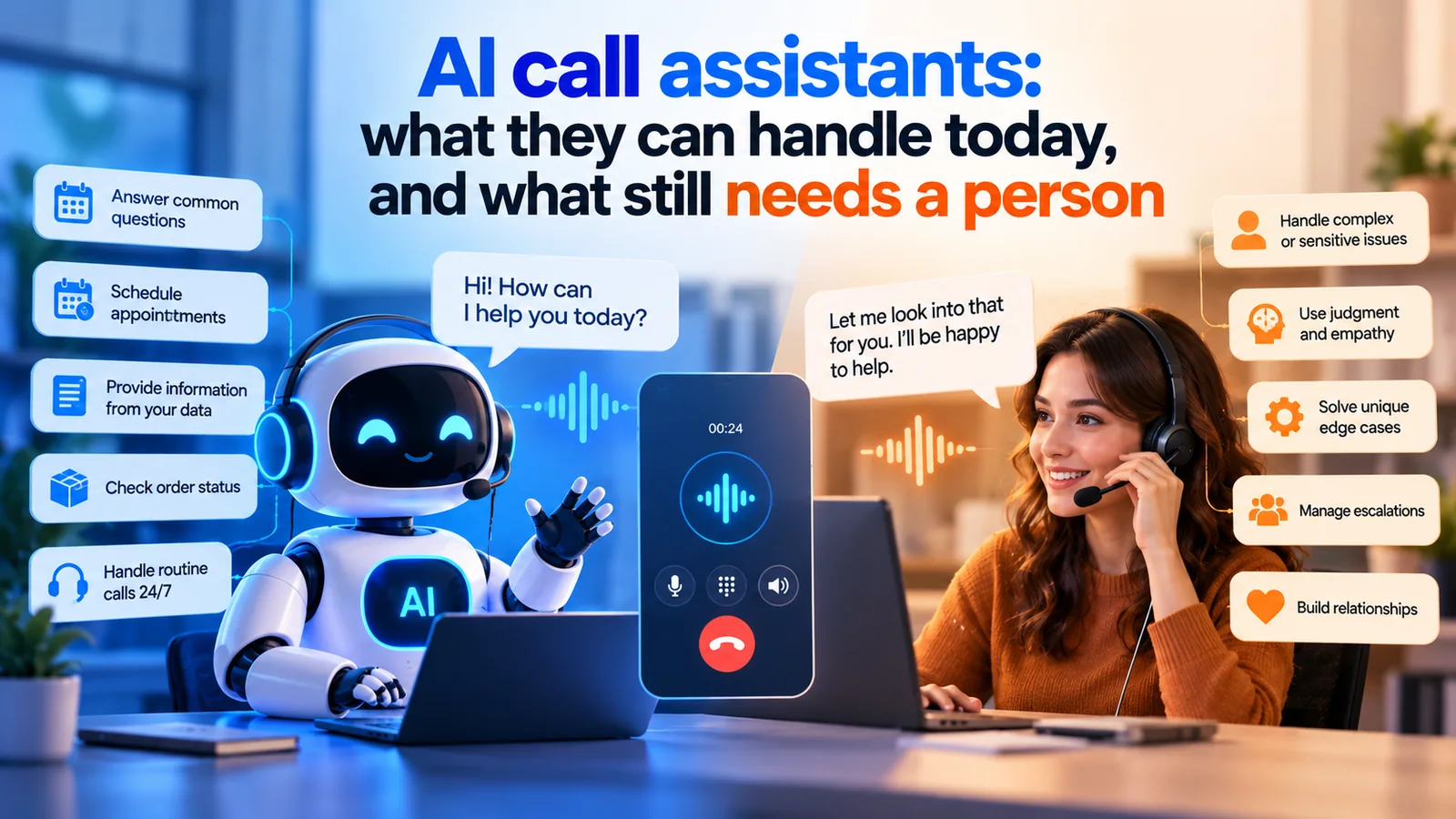
At the top end, the chatbot stops being a Q&A widget and becomes a system that acts: checking real availability and booking appointments, creating support tickets, updating your CRM, or holding spoken conversations. Each capability is a separate integration with its own edge cases — what happens when the calendar API is down, or a caller changes their mind mid-booking? We wrote separately about what AI call assistants can handle today — and what still needs a person. Expect this tier to be scoped like a proper software project, because that is what it is.
What drives AI chatbot development cost
Two quotes for “a chatbot” can differ by a factor of ten and both be honest. The difference is always in the details below — check which of these each quote actually includes.
Scope and intelligence
The single biggest driver is how much the bot needs to understand. Answering twenty FAQs in one language on one channel is a contained problem. Handling hundreds of topics in three languages — on your website, WhatsApp and Instagram — multiplies the conversation design and testing work for each channel. Multilingual support is rarely a toggle; every language needs its own testing pass.
Integrations with your systems
A standalone bot that answers questions is one project. A bot that reads from and writes to your booking system, CRM or helpdesk is a bigger one. Each integration means API work, authentication, error handling and testing against the real system — and real systems have quirks that only surface during testing. In our experience, integrations are where fixed-price quotes most often break down, so ask any agency exactly which integrations are in scope and what happens when an API behaves unexpectedly.
Your content and training data
An AI chatbot is only as good as the knowledge behind it. If your FAQs, policies and product information already live in clean, up-to-date pages, training is straightforward. If that knowledge is scattered across old PDFs and email threads, someone has to extract and structure it before the bot can use it — usually the agency, billed by the hour or folded into the quote. Businesses that tidy their content before the build consistently get better bots for less money.
Conversation design, testing and polish
The visible part of a chatbot project is the code; the expensive part is often the conversation design. Mapping the paths visitors actually take, writing fallback behaviour for misunderstandings, and designing a graceful handoff to a human all take time. A bot never tested with real customers will fail in ways nobody predicted — usually in its first week live. Budget for at least one round of refinement after launch, not just the build.
The ongoing costs most quotes leave out
A chatbot is not a website you build once and forget. Almost every quote covers the project; far fewer spell out what the bot costs to run. Ask about these before you sign.
AI chatbots consume computing resources with every message. The underlying language models typically charge per message or per thousand words processed, so your running cost scales with traffic — a quiet bot costs little, a busy one proportionally more. Messaging channels add their own fees: WhatsApp’s business API, for example, charges per conversation. For most small and mid-sized businesses these usage costs are modest next to the build price, but they are real and recurring, and worth modelling against your expected message volume before you commit.
Maintenance, retraining and monitoring
Your business changes — prices, policies, products, opening hours — and the bot’s knowledge has to change with it. Someone must review conversations the bot handled badly and keep integrations working as third-party APIs evolve. Most agencies, including ours, offer this as a monthly support plan; the alternative is letting the bot quietly go stale, which is how chatbots earn their reputation for wrong answers.
How to get a quote you can trust
Price ranges are useful, but your project needs a number attached to a scope. These five questions separate serious proposals from guesswork:
- What exactly is in scope? Number of topics, languages, channels and integrations — in writing, not implied.
- What happens when the bot does not know the answer? Look for a designed fallback and human handoff, not a shrug.
- Who prepares the training content? If it is you, budget your team’s time. If it is the agency, it must be in the quote.
- What does it cost per month after launch? Usage, hosting and maintenance — all three, as numbers.
- How do we measure whether it works? Resolution rate, escalation rate, booked appointments — agree the metrics before the build, not after.
An agency that answers these crisply will usually quote fairly. One that waves them away will cost you more later, whatever the initial number.
Frequently asked questions
How long does it take to build an AI chatbot?
Typically two to four weeks for a simple scripted bot, four to eight weeks for an AI chatbot trained on your business content, and eight to sixteen weeks for an advanced assistant with integrations or voice. Content gathering is the most common cause of delays — projects stall far more often waiting on training material than on engineering.
Can a chatbot replace my support team?
In our experience, no — and be wary of anyone who promises otherwise. A good chatbot handles repetitive tier-one questions, freeing your team for the complex cases where humans genuinely add value. Think triage and deflection, not replacement.
Do I need a huge amount of data to train a chatbot?
Not huge — but it needs to be accurate and organised. A few dozen well-written help pages will outperform thousands of messy documents. Quality and structure matter far more than volume.
What does a chatbot cost per month after launch?
It depends on traffic and the support arrangement. Usage-based AI and messaging fees scale with message volume and are typically modest for small businesses; a maintenance plan covering monitoring and retraining is usually a fixed monthly fee. Ask for both numbers separately before you sign.
Talk to us about your chatbot project
If you are weighing up whether a chatbot makes sense for your business — and what it would realistically cost — the fastest way to find out is a conversation. Book a free strategy call: we will talk through your use case, tell you honestly which tier fits, and send a fixed quote. We reply within 24 hours.