AI Customer Support: Faster Replies, Human Touch Kept
AI customer support can speed up replies without losing the human touch. Learn what to automate, what to keep human, and how to start.
 Talha Javed7 min read
You want an AI that knows your business. It should answer customer questions using your price list, your policies, and your product details, not generic knowledge from the internet. Two approaches dominate that conversation: fine-tuning and RAG. Vendors will tell you one of them is the answer. The honest answer is that they solve different problems, and most businesses need to understand both before spending anything.
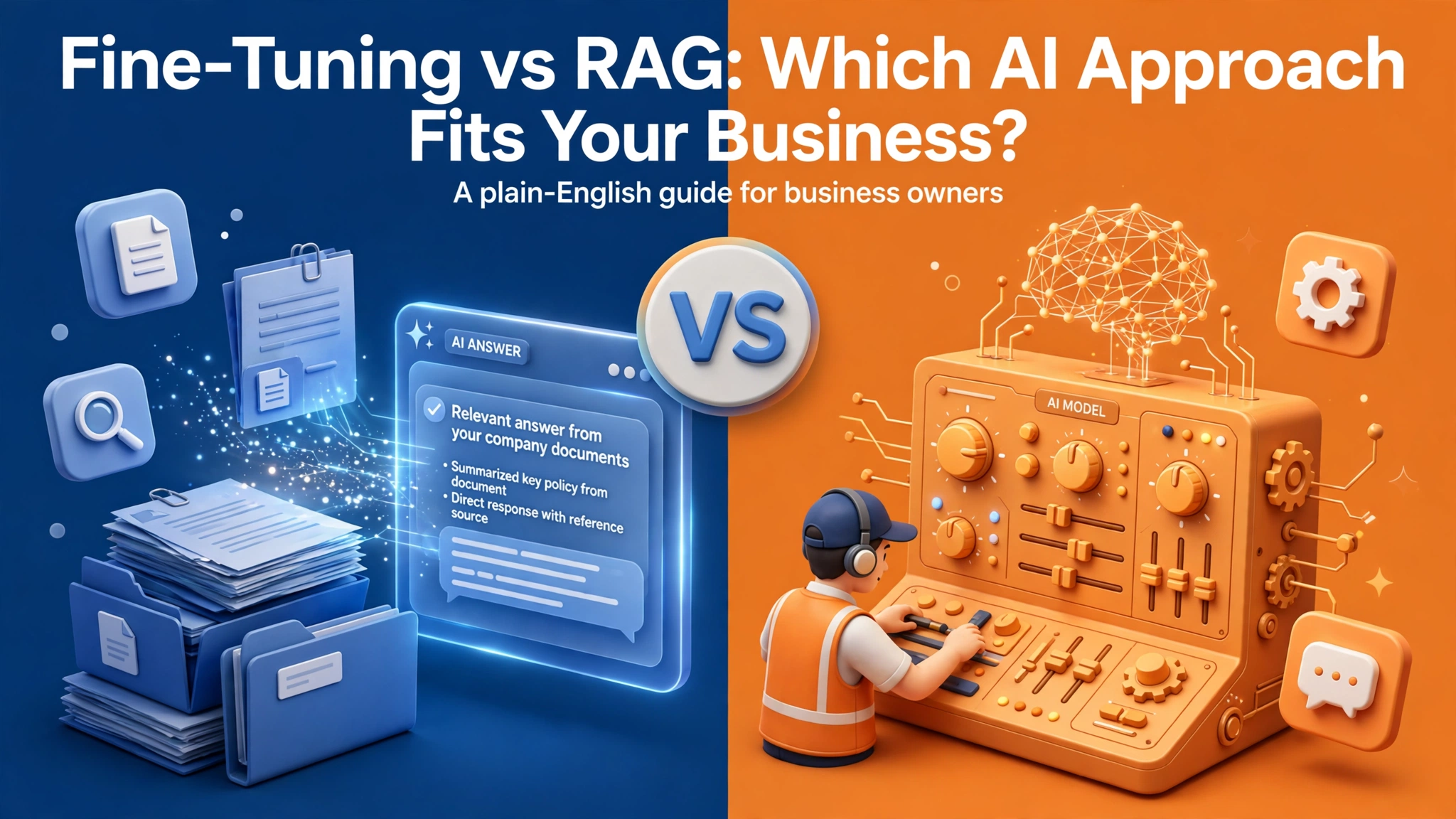
RAG stands for retrieval-augmented generation. The name is clumsy, the idea is simple. When a user asks a question, the system first searches your own documents for the relevant passages, then hands those passages to the AI along with the question. The AI answers using your material, not its memory.
RAG works best when the knowledge lives in documents: policies, manuals, product catalogues, FAQs, price lists, contracts, and support articles. It is the natural choice for a support chatbot, a booking assistant that needs to know your services and prices, or an internal tool that answers questions from a company handbook. Its strength is that it is grounded: the answer can point back to a source document, which makes it easy to check and easy to trust. Its weakness is that it can only answer what the documents contain. If the answer is not in your files, RAG cannot invent it, and it should not try.
For the full picture of how this works in practice, read our guide on how RAG chatbots work.
Fine-tuning takes an existing AI model and trains it further on examples of the behaviour you want. You show it hundreds or thousands of examples: this kind of question gets this kind of answer, in this tone, in this format. Over time the model shifts towards your style.
Fine-tuning is the right tool when the problem is behaviour, not knowledge. You want replies in a particular tone, for example warm and formal for a clinic, or short and direct for a delivery company. You want answers in a strict format, such as a structured summary or a machine readable record your software can use. You want the model to follow a process, such as asking two clarifying questions before giving a price.
RAG is usually the cheaper and faster route to a working product. You need your documents organised, a way to search them, and a prompt that tells the model to use the retrieved text. A first version can be built and tested in weeks. The ongoing cost is the search and the model calls, which scale with usage, plus the work of keeping documents current. That last part matters. RAG is only as good as the documents behind it, and outdated, duplicated, or contradictory files produce outdated, confused answers.
Fine-tuning costs more upfront. You need a dataset of good examples, which takes real time to prepare. Someone has to write or curate those examples, check them, and test the result. Training itself has a cost, and every retrain has a cost. For a small business, the dataset is often the hardest part. A few dozen examples will not change a model’s behaviour. You need volume, and volume means work. There is also a hidden cost: evaluation. You have to test the tuned model against the original on real questions, and decide whether it actually got better. Many teams skip this and assume the training worked. In our experience, that assumption is where fine-tuned projects quietly go wrong.
If you are budgeting either approach, our guide on how much AI chatbot development costs explains the cost drivers in detail.
RAG reduces made-up answers because the model is told to answer from the retrieved text. When the retrieved text is good, answers are accurate and checkable. But RAG has its own failure mode. If the search finds the wrong document, the model will confidently answer from the wrong document. Good search and well organised documents are not optional extras. They are the product.
Fine-tuning does not fix hallucination. A tuned model can still invent facts, and because it now sounds more like your business, the invented facts can sound more convincing. Fine-tuning changes how the model speaks, not how much it knows. If your problem is wrong answers, fine-tuning alone will not solve it. The practical rule is simple. If accuracy about your facts is the priority, start with RAG. If consistent tone and format is the priority, consider fine-tuning. If you need both, use both, with RAG supplying the facts and fine-tuning shaping the delivery.
RAG is the right choice in most business cases we see. Your knowledge changes often: prices, policies, menus, schedules, and product lists change regularly, and with RAG you update a document and the answers follow. No retraining, no waiting. Your knowledge already exists in documents. Most businesses have the material: a website, a price list, a handbook, a set of FAQs. RAG puts that material to work directly. You need answers you can check. In trust sensitive work, such as clinics, legal services, or finance, being able to show the source document behind an answer is a real advantage. And you want to start quickly and learn. A RAG system can be live in weeks, and you learn from real user questions what is missing.
Fine-tuning earns its keep in a smaller set of cases. You need a consistent voice at scale: a brand that answers thousands of messages a day needs every reply to sound like the same company, and fine-tuning bakes that voice in. You need strict output formats: if your software reads the AI’s reply, for example to create a booking or a ticket, the format must be exact every time. You need the model to follow a process, such as always asking for an order number first, or always qualifying before quoting. And you have a narrow, stable task with plenty of examples, such as sorting incoming messages into categories or summarising long tickets into short notes. Fine-tuning wins when the task is stable, the format matters, and the examples are available. It loses when the knowledge changes often or the facts are the hard part.
The strongest systems we build use both. RAG supplies the facts. Fine-tuning shapes the behaviour. A customer asks about a product. RAG finds the product details. The tuned model turns those details into a reply in the right tone, in the right format, with the right follow-up question.
Where does the knowledge live? If it lives in documents, start with RAG. If it lives in how your team behaves, look at fine-tuning. How often does the knowledge change? Weekly or monthly changes point to RAG. Stable behaviour over months points to fine-tuning. What is the failure you fear most? Wrong facts point to RAG. Wrong tone or wrong format points to fine-tuning. Do you have training examples? Fine-tuning needs hundreds of good examples. If you do not have them, and cannot create them, RAG is the practical choice. What is the budget for maintenance? RAG needs document upkeep. Fine-tuning needs retraining. Both need ownership, so pick the maintenance your team will actually do. And can you test it? Whatever you build, test it with real questions from real users before you trust it. The test set matters more than the technique.
Usually, yes, to build and to maintain. RAG needs organised documents and a search layer, and updates are as simple as editing a file. Fine-tuning needs a curated dataset, training runs, and retraining whenever the behaviour or the facts need to change.
No. Fine-tuning changes how a model behaves, not what it knows. For questions that depend on your current prices, policies, or product details, you still need the model to look up the facts. That is what RAG does.
Ask two questions. First, where do the answers come from: a document search, or the model’s training? Second, what happens when a price changes: do we edit a file, or retrain a model? The answers will tell you which approach you are buying.
Most businesses should start with RAG. It is faster, cheaper, easier to keep current, and easier to check. It solves the problem most businesses actually have, which is an AI that answers from their own material instead of guessing. Fine-tuning is a real tool, and it matters when tone, format, or process is the problem. It is not a shortcut to knowledge, and it is not a fix for wrong answers. The teams that get the best results use RAG for the facts and fine-tuning for the delivery, in that order.
If you are planning an AI assistant, a support chatbot, or a booking assistant for your business, book a free strategy call. We will look at your documents, your questions, and your customers, and recommend the approach that fits, RAG, fine-tuning, or both. You will leave with a clear plan and a price range, whether or not you hire us. We reply within 24 hours.
More from the studio.
AI customer support can speed up replies without losing the human touch. Learn what to automate, what to keep human, and how to start.
Talha Javed7 min readAI lead qualification explained: how automated scoring, routing and follow-up sort real buyers from casual browsers, and what to set up first.
Talha Javed7 min readAI agents vs chatbots explained: what each one actually does, when a simple chatbot is enough, and when you need an agent that can take action for you.
Talha Javed7 min readA free 30-minute call with a senior engineer. You leave with a plan and a price range, whether or not you hire us.