PostgreSQL vs Firebase: Choosing Your App's Database
PostgreSQL vs Firebase: which database fits your app? Compare data models, scaling, pricing and vendor lock-in, and pick the right foundation for your product.
 Talha Javed7 min read
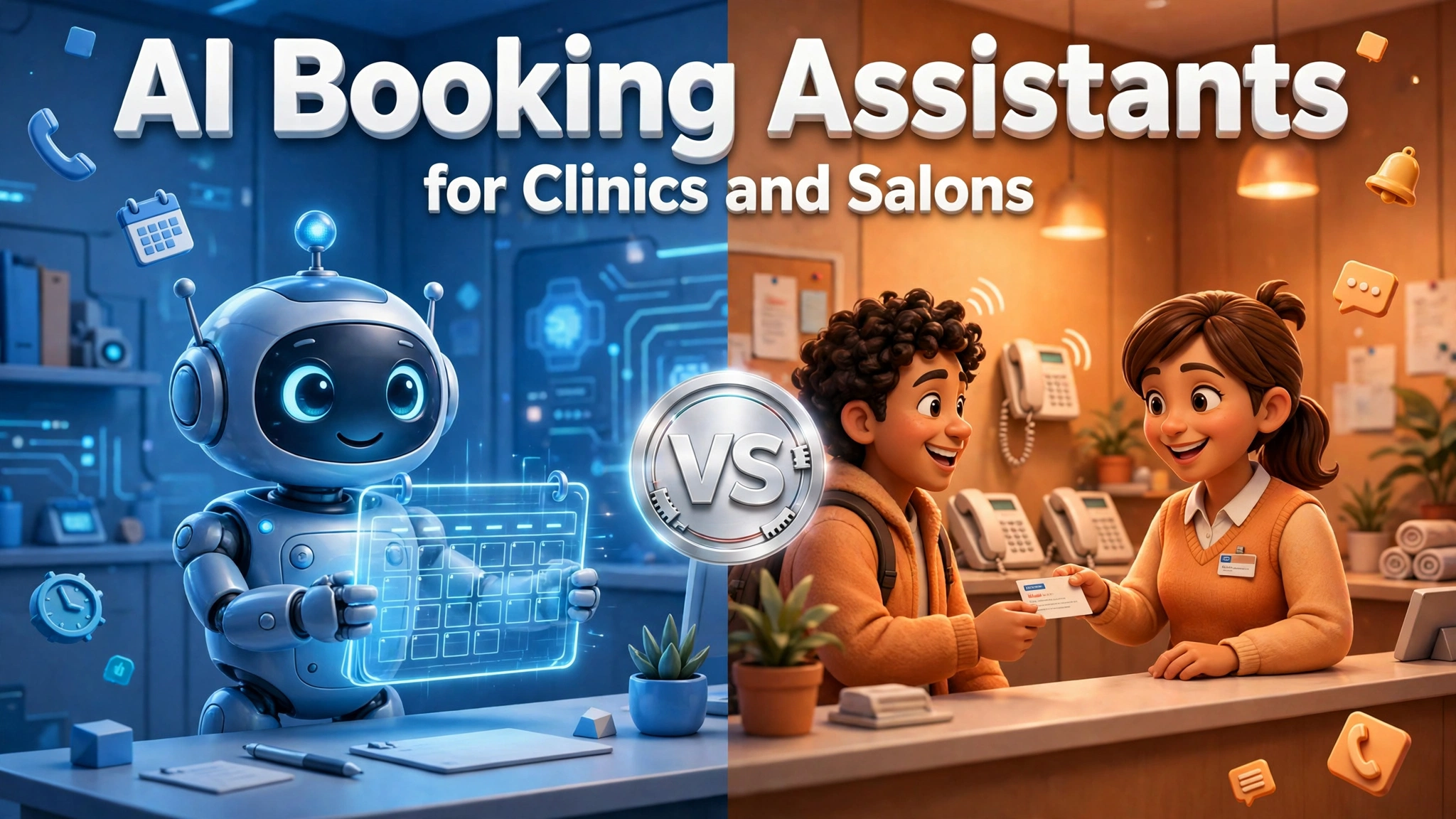
The phone rings at your front desk. Someone is already at the counter asking to move Friday’s appointment. And somewhere in all of that, a new customer hangs up after six rings and books with your competitor.
If you run a dental clinic, a physiotherapy practice, a beauty salon, or a barbershop, this scene is not hypothetical — it is Tuesday. You are almost certainly missing bookings. The question is whether an AI booking assistant is the right way to stop missing them, and what “right” actually looks like in practice. This guide answers both, without the sales pitch.
Strip away the marketing and an AI booking assistant is software that handles the scheduling conversations your receptionist handles today: answering “do you have anything Thursday?”, booking the slot, sending the reminder, moving the appointment when plans change. The difference: it works on every channel at once — phone, WhatsApp, website chat, Instagram DMs — and it never lets a ringing phone go unanswered at 11pm.
There are two flavors. A chat-based assistant lives in messaging apps and your website widget. A voice-based assistant picks up actual phone calls. Most clinics and salons end up needing both — older patients still call, younger clients still message — but the engine, a language model connected to your real availability, is the same.
Be blunt about what these systems are not: they do not replace your receptionist’s judgment. They replace the repetitive parts — the sixth “what time do you close?” of the hour, the reminder calls, the back-and-forth over three proposed slots. Your front desk keeps the difficult conversations. The assistant takes the routine ones, which are the majority.
Not every business needs one — a plumber taking three calls a day does not. Clinics and salons do, for three structural reasons.
First, the booking conversation is highly structured: a service, a provider, a date, a time. That tiny vocabulary is exactly where AI is most reliable, because there is very little room for the model to wander off script.
Second, no-shows are expensive and preventable. An empty chair is revenue that can never be recovered. In our experience, the single biggest return from these systems is not the bookings they take — it is the reminders they send, relentlessly and on time, to every client, every time. Humans send reminders when they have a spare minute. The assistant sends them always.
Third, your clients already try to book outside your hours. People browse salon services at 9pm. If booking requires a call during office hours, a chunk of that demand evaporates. An assistant that books at midnight converts demand your current setup cannot even see.
The assistant is a language model wrapped in guardrails and connected to three things: your calendar or booking system (real availability in, real bookings out), your service menu (a balayage takes two hours, a check-up takes thirty), and your business rules (deposits, cancellation windows, opening hours). It figures out the intent — new booking, reschedule, cancel, or just a question — and either answers or writes the booking.
The part that matters most is the calendar integration. An assistant reading availability from a spreadsheet updated “when she gets a chance” will double-book you. Insist on a live, two-way sync with the single source of truth for your diary: Fresha, Booksy, Timely, Pabau, Cliniko, Dentally, Google Calendar — whatever you actually use.
Then there is the handoff. A good system knows what it does not know. When a client asks something outside its scope — a medical question, a complaint about a previous visit — it should say so plainly and route to a human, with the full transcript attached. Ask the vendor: “what does it do when someone asks something it cannot answer?” If the answer is vague, keep looking. One more transparency check: the assistant should identify itself as automated in its first message — trust is easier to keep than to rebuild.
Pricing in 2026 falls into two buckets. Subscription platforms charge a monthly fee, typically in the low hundreds per month for a single location, for an assistant you configure yourself. Fine for simple service menus; the trade-off is that the assistant is only as good as your configuration.
Custom-built assistants are designed around your specific workflows and priced as a project plus a smaller ongoing fee. Our breakdown of AI chatbot development costs covers the same pricing logic.
Measure the cost against the cost of the status quo: the salary-hours spent on scheduling, the no-shows you absorb, the after-hours bookings you lose to competitors who answer. Run your own numbers with your own no-show rate, not a vendor’s.
The technology is the easy half. The rollout is where these projects succeed or die, and it comes down to four decisions.
1. Define the assistant’s job description. Write down what it is allowed to do and what it must escalate: discounts, cancellation-policy overrides, services needing a human callback before confirming. The vendors who ask for this document upfront are the ones who have done this before.
2. Train your staff before the clients meet it. Make sure your receptionist knows the assistant is taking the routine work — not replacing her. Rollouts fail socially more often than technically: let the team test it first and give them an override switch they trust.
3. Start with one channel. Do not launch on phone, WhatsApp, website, and Instagram on day one. Pick the channel where missed bookings hurt most — for most clinics the phone, for most salons Instagram or WhatsApp — and nail it there first. Add the rest in weeks.
4. Review the transcripts weekly for the first month. Every conversation is a free audit of your booking process: clients asking about a service you do not list clearly, a policy that confuses people, one scenario the assistant gets confidently wrong. Read a sample weekly and fix what you find.
Accent and audio edge cases. Voice assistants have improved enormously, but a client calling from a noisy street on a bad connection can still confuse them. The mitigation is the handoff: if confidence drops, the assistant should text a booking link or transfer to your desk rather than guessing.
Complex multi-person bookings. “My whole family needs check-ups Saturday morning” is genuinely hard. A good system handles the simple version and escalates the rest. Do not let a vendor demo only the happy path; give them your hardest real booking scenario.
Data privacy. A booking assistant handles names, phone numbers, and in clinics, health-adjacent information. Ask where conversation data is stored, who can see it, and how long it is kept — and get it in writing. If you operate in the EU or the UK, your vendor needs to talk GDPR without flinching. A dealbreaker question, not a nice-to-have.
It depends on your booking volume and no-show rate, not your size. A two-chair barbershop with loyal regulars and a paper diary that works may genuinely not need one. A four-room dental clinic losing two slots a day to no-shows and missing evening calls absolutely does.
Decide with a two-week experiment, not a whitepaper. Count your missed calls, no-shows, and after-hours enquiries for fourteen days. Multiply the no-shows by your average appointment value. Compare that real number against the monthly cost of an assistant. If the gap is obvious, you have your answer. If it is close, start with automated SMS reminders — they recover a surprising share of no-shows for very little.
If you go ahead, treat the assistant like a new hire: a clear job description, a proper introduction to the team, early supervision, and the difficult conversations kept human. The businesses that get the most from AI booking are not the ones with the fanciest technology — they are the ones that did the boring rollout work properly.
No — it changes what she spends the day on. The routine scheduling calls and reminder chasing go to the assistant; the human keeps the anxious patients, the complaints, the exceptions, and the in-person welcome. Most practices keep the same staff doing higher-value work, not fewer staff.
A subscription platform can be live in a week if your service menu and policies are ready. A custom build typically takes four to eight weeks, most of it spent on calendar integration and testing edge cases. Ask about the integration first — it determines the timeline.
It should recover gracefully in the moment (apologize, offer a human) and log the failure for review. Weekly transcript reviews in the first month catch the patterns — usually one or two scenarios the configuration missed.
If missed calls, no-shows, and after-hours enquiries are costing your clinic or salon real revenue, an AI booking assistant is one of the highest-return investments you can make this year — if it is wired into your real calendar and rolled out with your team. If you want help scoping one, see how we build AI solutions, or book a free strategy call — we will tell you honestly whether you need one. We reply within 24 hours.
More from the studio.
PostgreSQL vs Firebase: which database fits your app? Compare data models, scaling, pricing and vendor lock-in, and pick the right foundation for your product.
Talha Javed7 min readHow our app development process works, from the first kickoff call to App Store launch: phases, handoffs, and habits that keep a build on schedule and budget.
Talha Javed7 min readREST vs GraphQL explained for founders: what each API style does well, where it costs you, and how to choose the right one for your product in 2026.
Talha Javed7 min readA free 30-minute call with a senior engineer. You leave with a plan and a price range, whether or not you hire us.