Next.js vs Flutter Web: Choosing the Right Stack
Choosing between Next.js vs Flutter Web? Compare SEO, performance and team costs, plus the real cases where each wins — and pick the right stack.
 Talha Javed7 min read
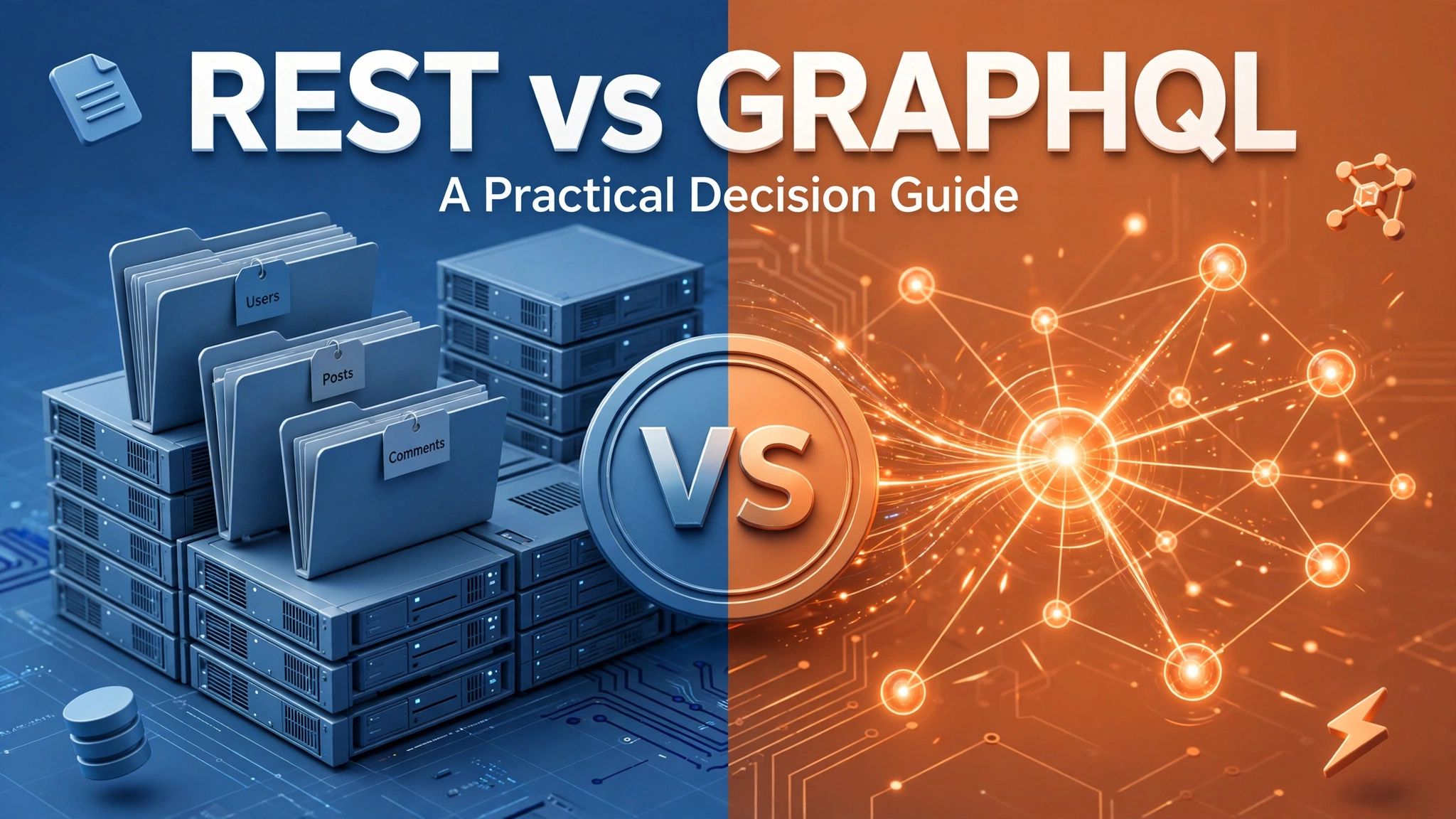
Every app you have ever used is really a conversation between two things: the screens you see and the server that holds the data. The API is the language of that conversation, and the choice of that language shapes how fast your product gets built, how it performs on a bad mobile connection, and how much your backend costs to change later. For years the debate has been framed as rest vs graphql, as if one of them must win. The right question is more useful: which one costs less for the specific product you are building? This guide explains both in plain terms and gives you the decision rule we run through with clients.
REST is the original way of building web APIs, and it won because it is simple to reason about. Every piece of data lives at its own address — a URL. Want a user? Go to /users/123. Want their orders? Go to /users/123/orders. Each address speaks the same small vocabulary: GET to read, POST to create, PUT to update, DELETE to remove. A new developer can look at an API’s list of addresses and understand most of the system in an afternoon.
That address-per-resource design gives REST three genuine superpowers. First, caching is trivial: each URL means one thing, so the result can be stored at the edge and reused for every visitor asking the same question. For content that is the same for everyone — blog posts, product listings, documentation — that caching is a huge performance and cost win, as we described in our headless CMS guide. Second, the tooling is mature: documentation generators, testing tools, API gateways, and monitoring all grew up around REST. Third, every backend developer already knows it — hiring is easy and onboarding is fast.
The weaknesses show up as products grow. Each endpoint returns a fixed shape — whatever the server decided you would need. Your mobile app’s home screen might need a user’s name and their last three order totals; the REST endpoint for a user hands back the entire user object including fields nobody asked for (over-fetching), and the orders live behind a second request (under-fetching). So one screen becomes three round trips, each with its own latency — and on a flaky mobile connection the app starts feeling slow in a way no frontend polish fixes. The other quiet cost is versioning: when the data shape has to change, you either break every existing client or maintain /v2/, then /v3/, while the codebase accumulates parallel universes.
GraphQL keeps the same job — moving data between server and screens — but flips the control. Instead of dozens of fixed addresses, there is one endpoint, and the client describes exactly the data it wants. That home screen becomes a single request: this user’s name, plus the totals of their last three orders. Over-fetching and under-fetching disappear by construction.
The mechanism behind this is the schema: a typed contract listing every kind of data the API can serve and how the pieces connect. That contract is self-documenting — tools read it and generate explorers, autocomplete, and client code — and it is checked continuously: if the frontend asks for a field that no longer exists, the request fails loudly at build time instead of silently breaking in production. In our experience, that typed contract is the underrated half of GraphQL’s value.
GraphQL also decouples frontend speed from backend speed. With REST, every new field on a screen means someone builds or changes an endpoint — the frontend waits on the backend. With GraphQL, the frontend team can usually reshape their queries against the existing schema without touching the server. For products where the app’s screens change weekly and the backend team is small, that independence is worth real money.
REST wins when:
GraphQL wins when:
REST’s hidden costs are endpoint sprawl and versioning: a mature REST API can grow hundreds of endpoints, each with its own quirks, and every breaking change spawns a new version that must be maintained as long as old app versions are in the wild. Mobile apps on REST also tend to make many small requests per screen, and on high-latency networks that chattiness is the dominant performance cost.
GraphQL’s hidden costs are different and less familiar to teams adopting it for the first time. Because clients can ask for anything the schema allows, they can also ask for absurdly expensive things — a deeply nested query that fans out into thousands of database reads. You need query depth limits, cost analysis, and timeouts, or one curious client can take down your database. Caching is the other real cost: REST responses cache at the URL level almost for free, while GraphQL’s single-endpoint design forces you to work for it — persisted queries and cache normalization on the client, careful strategies on the server. Then there is the N+1 problem: naive GraphQL resolvers trigger one database query per item in a list, so the backend team needs batching discipline from day one. None of this is a dealbreaker, but it is genuine backend engineering work, not configuration.
In short: REST’s costs arrive slowly, as maintenance drag. GraphQL’s arrive up front, as engineering you must do properly from the start.
Most real products do not pick a side — they use both, each where it fits. The pattern we reach for most often is the backend-for-frontend approach: the mobile app talks to a GraphQL layer shaped exactly for its screens, the public partner API stays REST for stability, and both sit on top of the same underlying services. Each surface gets the API style that suits its consumers, and neither is compromised for the other.
This is the same instinct behind our boring-backend philosophy: choose the simplest thing that survives contact with your actual product. For many client projects, that is REST plus one or two carefully tailored endpoints for the heavy screens — GraphQL’s benefits without its operational surface. We only reach for a full GraphQL layer when the product has the screen complexity or multi-source aggregation to justify it.
One more thing founders get wrong: GraphQL is a query layer, not a rewrite. You can start with REST and add GraphQL in front of the same services later, when the pain is real. Starting REST and graduating to GraphQL is a normal, healthy path. Starting with GraphQL because it sounds modern, then discovering your product only needed simple CRUD, is how you buy complexity on credit.
Yes. GraphQL resolvers can call your existing endpoints or services underneath, so the GraphQL layer starts as a translation tier and you migrate internals at your own pace. Plan authentication and rate limiting early, since those move from per-endpoint rules to per-query rules.
Not inherently. GraphQL typically means fewer network round trips, which helps most on slow mobile connections, but a badly designed GraphQL schema with unbatched resolvers can be slower than a tidy REST API. Performance comes from design discipline either way.
Usually not. A single web client with predictable screens is well served by REST, and you keep the easy caching. GraphQL earns its keep with multiple clients with different data needs — web plus mobile plus a partner integration — or when the frontend changes shape constantly.
Expect real backend engineering, not a weekend plugin: schema design, batched resolvers, query cost guardrails, and revised caching and monitoring. For a typical product it is measured in weeks of focused backend work — which is why we recommend it only when the product’s complexity justifies it.
Tell us what your app needs to do, and we will give you a straight recommendation — REST, GraphQL, or a mix — with what it would take to build. Book a free strategy call and a senior engineer will walk through it with you. You will hear back within 24 hours.
More from the studio.
Choosing between Next.js vs Flutter Web? Compare SEO, performance and team costs, plus the real cases where each wins — and pick the right stack.
Talha Javed7 min readHeadless CMS explained in plain terms: how it differs from a traditional CMS, where it shines, where it doesn't, and how to tell if you actually need one.
Talha Javed7 min readHubSpot, Zoho and Salesforce are the right answer for most companies. These are the signs that yours has outgrown them, and the three options you have when it does.
A free 30-minute call with a senior engineer. You leave with a plan and a price range, whether or not you hire us.