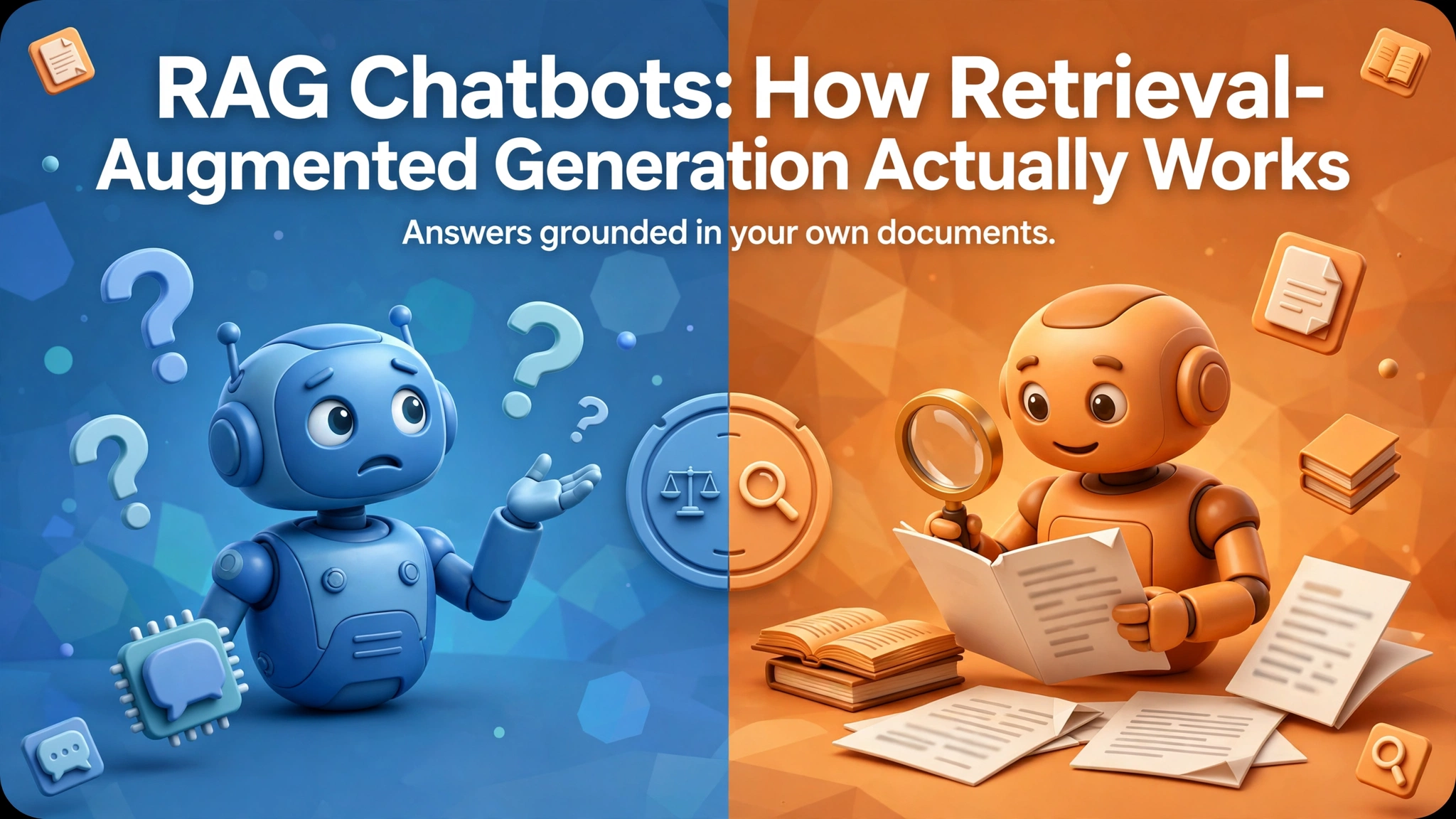
RAG Chatbots: How Retrieval-Augmented Generation Actually Works
A RAG chatbot explained in plain terms: how retrieval-augmented generation grounds answers in your own documents, and where it still needs care.
 Talha Javed7 min read
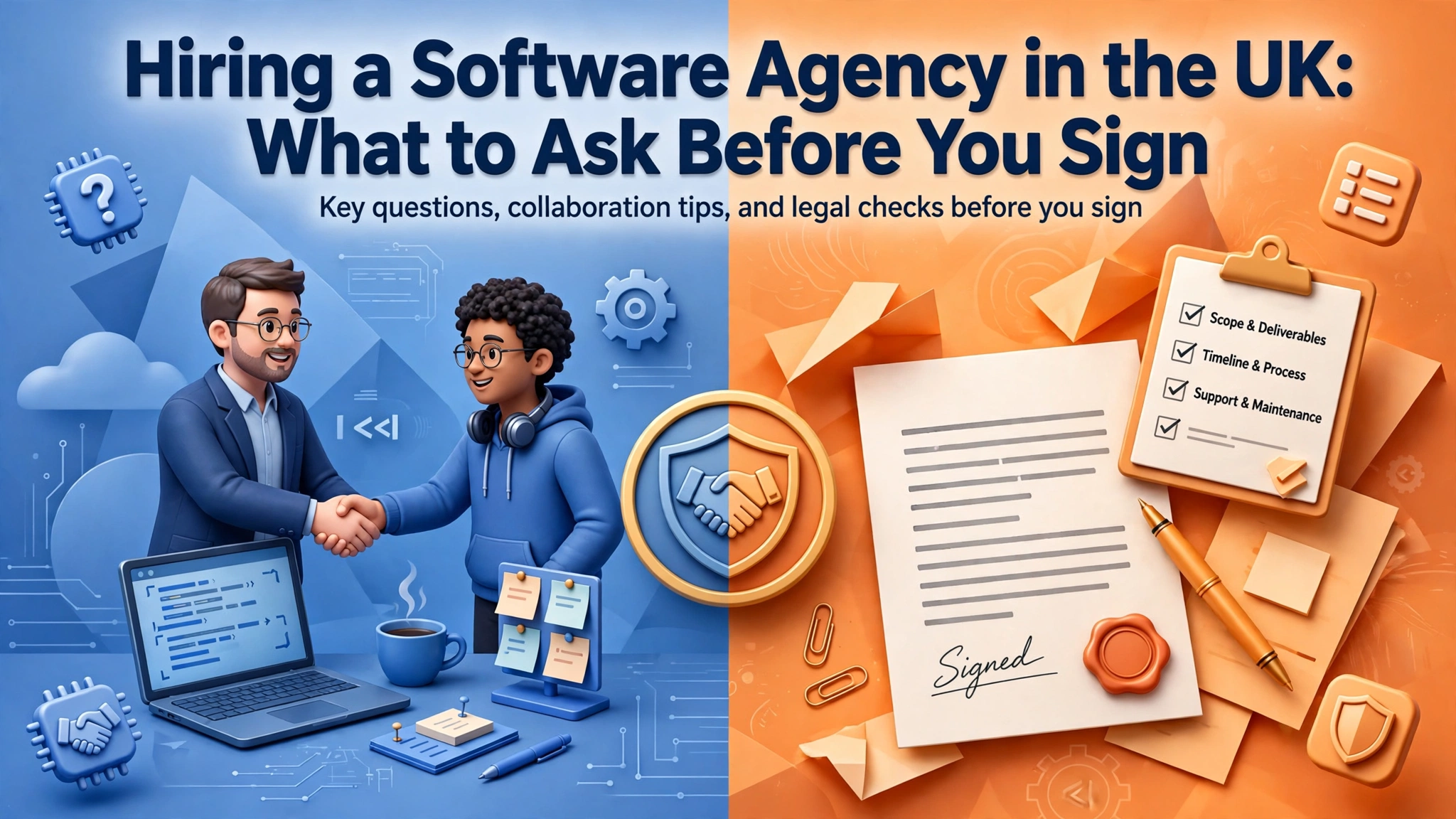
If you are about to hire a software agency in the UK, the most expensive mistake is not picking the wrong technology. It is signing a contract before you understand who will do the work, what you actually own at the end, and what happens when something goes wrong. A polished sales call tells you very little about any of that. The questions below do.
This guide is for founders and managers buying software for the first time, or looking for a cleaner second attempt after a bad experience. Use it as a checklist on your next call. A good agency will welcome these questions; one that dodges them is giving you an answer too.
Before comparing agencies, be clear about the result you are paying for. “We need an app” is not a brief; “a booking app that lets customers reserve, pay, and reschedule without calling us, ready before our busy season” is one an agency can price and plan around. Ask each agency what success would look like in the first three months after launch, and how you would measure it. A plan tied to bookings completed or admin time saved is harder to fake than vague promises about growth.
Also ask what the agency would not build: a team that pushes back on a costly feature with no user benefit will protect your budget later.
Agency websites show senior people, but projects are sometimes staffed by whoever is free. Ask directly: who is on my team, what is their experience, and will they stay until launch?
You do not need a large team: a small product often needs one lead developer, one designer, and someone owning the project day to day. What you do need is continuity. If the lead changes halfway through, you pay for the replacement to relearn your product. Ask how the agency handles holidays and turnover, and whether any work is subcontracted, if so, who has access to your code and data, and who is accountable?
Pricing confuses buyers because the same word can mean different things: a fixed price, an estimate, and a day rate are not interchangeable, and the difference usually lives in the small print.
Ask these questions, in plain language, and get the answers in writing:
A fixed price suits a clear scope, because the agency carries overrun risk, but only if scope is genuinely agreed first. A fixed quote after one short call should make you cautious: either changes will be charged later, or the price is padded. Time-and-materials suits evolving scope, but demands more oversight, since there is no ceiling unless you set one. Either way, agree a billing rhythm and a way to review spend before it surprises you.
Finally, be wary of a quote dramatically cheaper than every other one. It can mean junior staff, missing work like testing and deployment, or a team planning to recover margin through change requests.
This is the question buyers forget most often, and regret forgetting. Before signing, confirm you will own the source code, designs, and content, handed over in usable form at the end.
Ask where the code lives during the project, and whether you have access to it from day one. Ask who owns the accounts, domain, hosting, app store listings, analytics, third-party services. They should be in your name, or transferred to you on launch, so you are never locked out of your own product.
The same applies to data. If the software holds customer data, ask how it is stored, who can access it, and how you get a full export if you move to another provider. An agency that is confident about its work will not need to hold your code hostage to keep you as a client.
Good software is built in small, visible steps, not delivered as a surprise after months of silence. Ask how often you will see working software and how feedback is collected.
In our experience, a weekly rhythm works well: a short demo, a plain-language summary of what changed, and what comes next. You do not need daily meetings, but you do need a single point of contact. Ask what happens when you disagree with a recommendation, you want a team that explains its reasoning and records the decision, not one that quietly obeys even when it believes you are wrong. And ask what the launch date depends on. An agency that names the risks, late content, third-party approvals, app store review, is being realistic; one that promises a date with no conditions is selling, not planning.
Launch day starts the product’s life, not ends the relationship. Software needs updates and fixes, and users will find issues testing missed. Ask what support looks like in the first three months, and what it costs.
Clarify the difference between a bug and a new feature. Bugs in delivered work should be fixed under an agreed warranty period; new features are separate work. That boundary causes more arguments than almost anything else in agency relationships, so agreeing it before you sign saves money and goodwill.
Ask about response times, not just availability: a reply within one working day for a serious problem, and a fix timescale for a critical fault, are commitments you can hold a team to. If your product serves customers outside office hours, check whether support covers that.
Ask how the agency handles data protection, including UK GDPR, and where customer data is stored and processed. You do not need to become a lawyer to ask this, but you need an answer you can pass to your own advisers.
Ask which law governs the agreement and how disputes are handled. If you are a UK company signing with an overseas agency, that decides where you would have to go if things went badly wrong. And if your agency works in a very different time zone, agree on overlapping hours for calls and a response window for messages, so a simple question does not always cost you a day.
Ask for two or three references from clients with similar-sized projects, and actually call them. Ask what went wrong, not just what went well: how the agency handled a difficult week tells you more than a portfolio page.
Look at live work, not just screenshots: visit the websites and apps the agency built and check whether they still work well. A portfolio of projects now offline or broken is a warning sign, however beautiful the original designs were. Other red flags: pressure to sign quickly to “hold a slot”, refusal to put key promises in writing, no questions about your business or users, and a team that agrees with everything you suggest. Finally, trust the working relationship itself. If communication already feels slow, vague, or defensive during sales, it rarely improves once the contract is signed.
Typically two to four weeks: shortlist three or four agencies, call each, get written proposals from the strongest two, and check references before signing. Rushing it usually means skipping the reference checks, where the most useful information lives.
It depends on what you value. A UK agency may offer easier meetings, shared hours, and a familiar legal framework; a remote team may offer a lower price and wider talent pool. Judge the engagement, ownership, process, pricing, support, not the postcode.
Not always. Fixed price is safer when scope is clear; hourly billing can suit a product that will evolve, provided you set a budget ceiling and review spend regularly. The risky option in either case is a vague scope with no written rules for changes.
A one-page brief is enough: what the product must do, who will use it, what success looks like, your rough budget range, and your target launch window. A good agency will help you refine it, and how it does that is itself a useful test.
Choosing an agency is a decision you will live with for the life of your product. If you are weighing proposals, or unsure what a quote actually covers, a second opinion costs nothing and can save a great deal.
Book a free strategy call through our contact page and tell us what you are building. We will talk through your options, including whether we are the right team for it, and we aim to reply within 24 hours. You can also read our app development process guide, the same process we would follow on your project.
More from the studio.
A RAG chatbot explained in plain terms: how retrieval-augmented generation grounds answers in your own documents, and where it still needs care.
Talha Javed7 min readPractical ways to reduce AWS and GCP costs without slowing your team down: rightsizing, idle resources, storage tiers, and billing habits that stick.
Talha Javed7 min readProgressive web app vs native, compared honestly: cost, offline use, store reach and performance, so you can choose the right build for your product.
Talha Javed7 min readA free 30-minute call with a senior engineer. You leave with a plan and a price range, whether or not you hire us.