AI Receptionists for Dental Clinics: A Practical Guide
An AI receptionist for a dental clinic answers calls, books appointments and handles cancellations 24/7. What it does, what it costs, and what to check first.
 Talha Javed7 min read
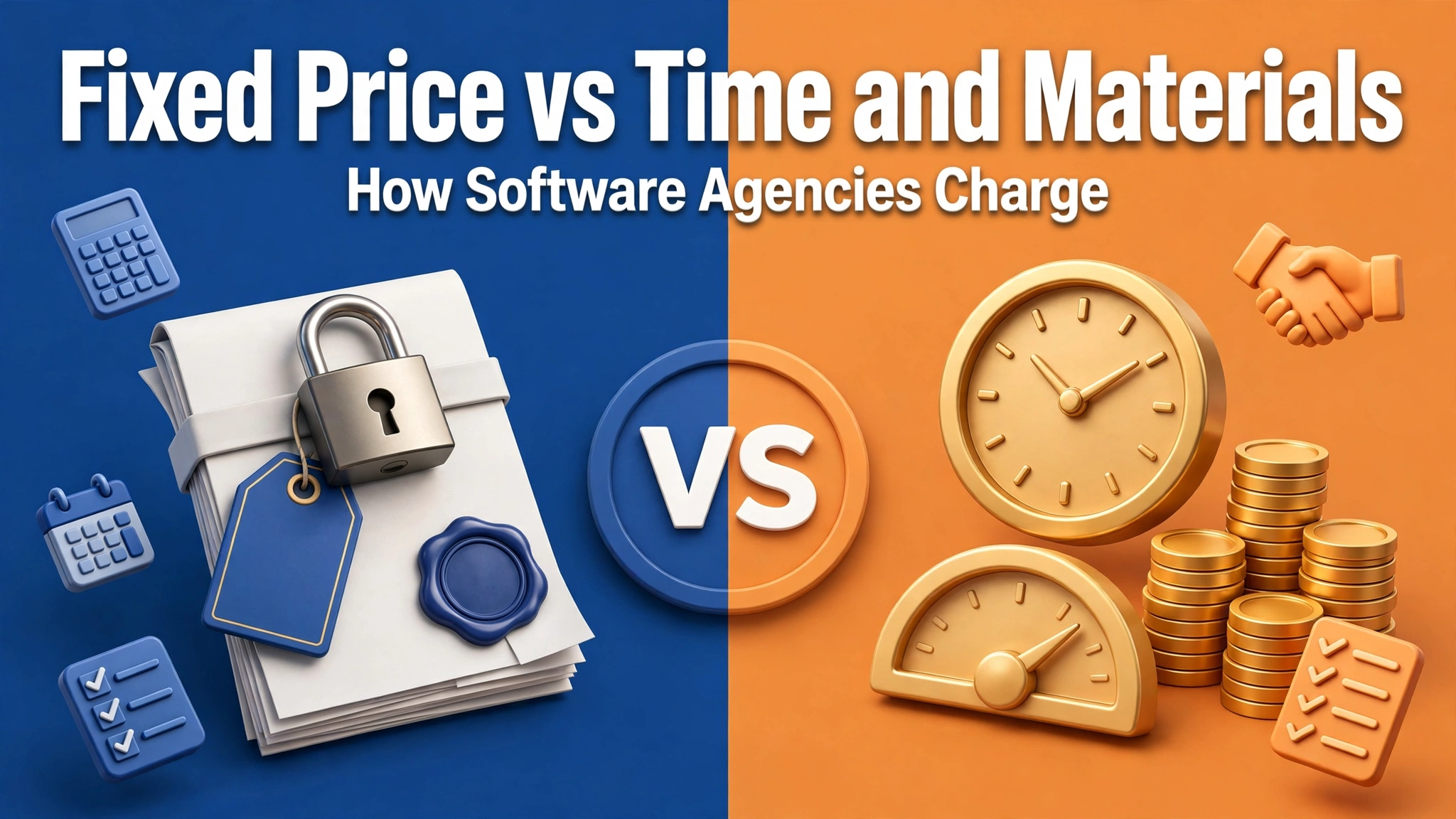
You have a project in mind and two quotes in front of you. One says a single fixed number. The other says an hourly rate and an estimate of hours. They look like the same offer written two ways, but they are not. They are two different deals about who carries the risk when the work turns out harder than expected.
Fixed price and time and materials are the two main software agency pricing models. This guide explains both in plain terms, when each one fits, and what to ask before you sign.
A fixed price quote says: this scope, this price, this date. The agency studies your requirements, writes down exactly what will be built, and commits to a number. If the work takes longer than expected, that is their problem. You pay the agreed amount, in agreed instalments, and you get the agreed scope.
The key word is scope. A fixed price only works when the scope is written down clearly enough that both sides agree on what is included. Vague scope is where deals go wrong, because the agency prices what they think you mean.
Fixed price suits a project with a clear end point: a marketing website, a booking system with known features, an MVP with a defined feature list. Our guide to what an MVP is and how much it should cost explains how a tight first version keeps a fixed price honest, because a tight scope is one you can actually define.
Time and materials, often shortened to T and M, works the other way. You pay for the hours the team actually works, at an agreed hourly or daily rate. The agency gives you an estimate, say eight to ten weeks, but it is not a promise. If the work takes longer, you pay for the extra hours. If it takes less, you pay less.
This model suits work where the end point is genuinely unknown: a product that will evolve as users try it, a legacy system nobody fully understands yet, or a long engagement where the roadmap changes monthly. In these cases a fixed price would be guesswork, and an honest agency will tell you so.
The risk sits with you, which is why transparency matters more here. You should see weekly reports of hours worked, what was delivered, and what is left. If an agency cannot show you what the hours produced each week, that is a problem with the agency, not the model.
Strip away the sales language and the difference is simple. Under fixed price, the agency carries the risk of underestimation. Under time and materials, you carry it. Everything else follows from that.
An agency taking fixed price risk protects itself in one of two ways: it prices in a buffer, which makes the quote look higher, or it defines the scope very tightly, so anything outside the list costs extra. Neither is dishonest. It is the price of certainty. When a quote looks surprisingly cheap, ask what was left out.
An agency working time and materials has no reason to pad the estimate, but it also has no financial reason to finish fast. That is a fact about incentives, not an accusation, and it is why weekly demos matter so much under this model. You should be able to see progress every week, not just hear about it.
Choose fixed price when you can answer yes to most of these:
One warning. Fixed price rewards a frozen scope, and a frozen scope can hurt a product. If you learn something important halfway through, changing direction means a change request, a new price, and a negotiation.
Choose time and materials when you can answer yes to most of these:
Time and materials is also the honest choice for rescue work: taking over a half built product or untangling a codebase the agency did not write. Nobody can price that fixed without guessing.
Most real projects are neither purely fixed nor purely open ended, and good agencies offer middle paths.
A capped time and materials deal sets a maximum. You pay for hours worked, but the agency commits not to exceed an agreed ceiling without your written approval.
A phased fixed price breaks the project into stages. Discovery and design are fixed first, then the build is quoted fixed once the requirements are known. This is, in our experience, the most honest way to price a project that starts vague: a small fixed amount to define the work, then a real fixed price for the build.
The model matters less than the details around it. Check these points in writing before you sign:
Our guide to hiring a software agency in the UK covers many of the same questions in more detail, and most of them apply wherever you are based.
A quote can look professional and still hide trouble: a fixed price with no written scope; an hourly rate with no estimate of hours and no reporting promise; a quote far below every other agency, with no explanation; most of the money asked upfront; no mention of code ownership; and no plan for scope changes, because they will come.
Not always. A fixed price includes a buffer for the agency’s risk, so it can look higher than an hourly estimate. But an hourly estimate is not a final price, and if the work runs long it can cost more. Compare the fixed price against the realistic top end of the hourly estimate, not the optimistic bottom end.
Yes, and it happens often. Start time and materials during discovery, then switch to fixed price once the scope is clear. Agree the switch in writing, including what has been delivered and paid so far.
Fixed price usually fits an MVP better, because an MVP has a defined feature list and a budget that cannot stretch. A fixed scope also stops an MVP growing into a full product before launch. If the MVP is really an experiment and you expect to change direction weekly, time and materials with a cap is safer.
That is the agency’s risk to carry, and a professional agency will carry it. What sometimes happens instead is quiet scope trimming, where features are delivered in a thinner form than you expected. Weekly demos are your protection: if you can see the software every week, you can spot thinning early.
There is no best pricing model, only a best fit. A well defined build with a fixed budget wants a fixed price. A product that will evolve wants time and materials, ideally with a cap. A vague project wants a phased approach, discovery first, then a real quote.
The model is a detail. What matters is the agency behind it: a written scope, weekly demos, honest reporting, and a contract that says who owns what.
If you are weighing quotes right now, book a free strategy call. We will look at your scope, tell you honestly which model fits and why, and give you a price range within 24 hours.
More from the studio.
An AI receptionist for a dental clinic answers calls, books appointments and handles cancellations 24/7. What it does, what it costs, and what to check first.
Talha Javed7 min readLanding page conversion explained: the anatomy of a high-performing landing page, from headline to form, and what to check before you pay for one.
Talha Javed7 min readZero downtime deployment explained for founders: how blue-green and rolling releases keep your app online during updates, and what to ask your team.
Talha Javed7 min readA free 30-minute call with a senior engineer. You leave with a plan and a price range, whether or not you hire us.