AI Customer Support: Faster Replies, Human Touch Kept
AI customer support can speed up replies without losing the human touch. Learn what to automate, what to keep human, and how to start.
 Talha Javed7 min read
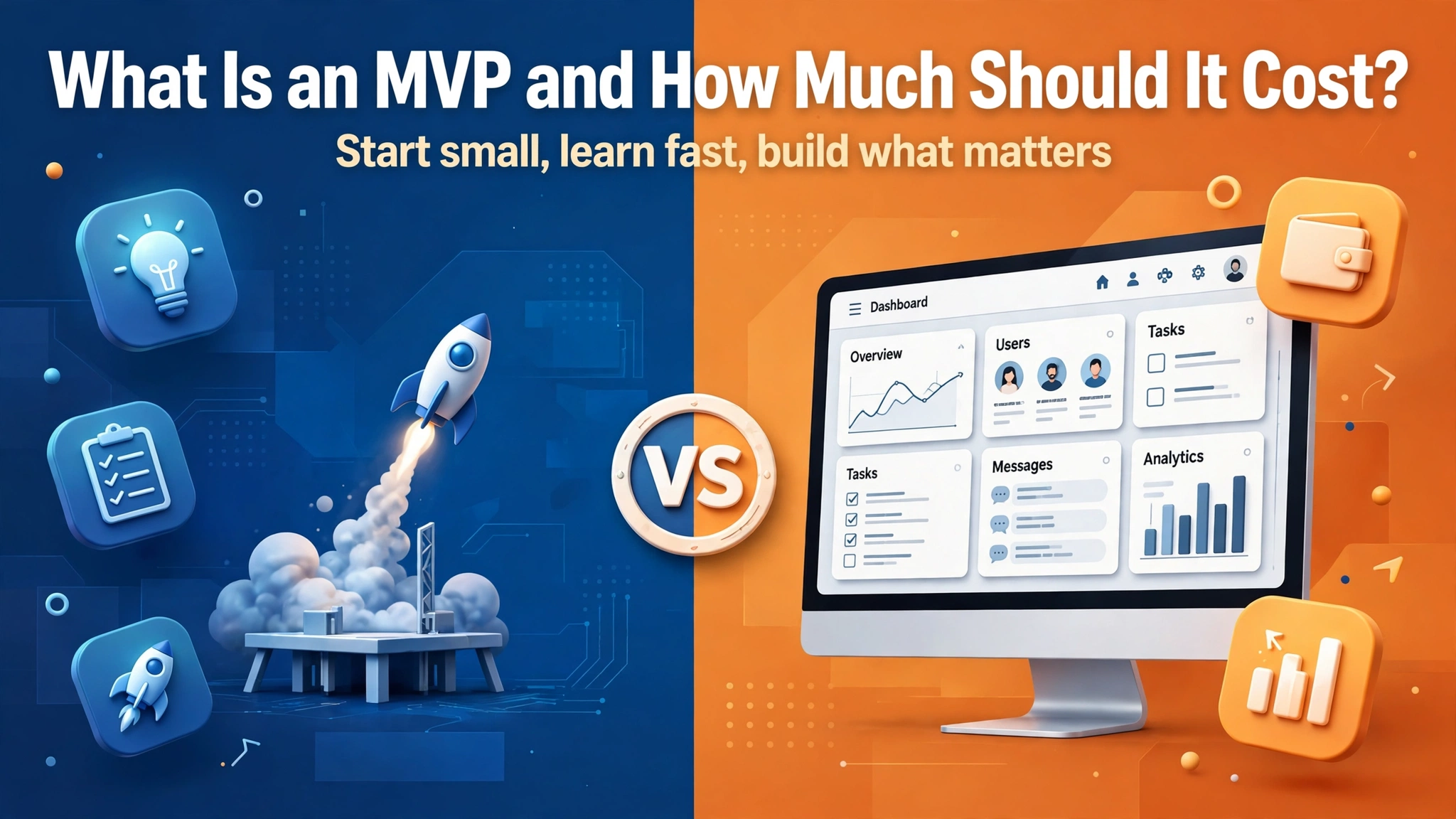
If you have an idea for an app or a web platform, you have probably heard the advice to build an MVP first. The advice is sound. The confusing part is what those three letters mean in practice, and what you should expect to pay. MVP stands for minimum viable product. It is the smallest version of your product that real users can try, use, and give honest feedback on. It is not a demo or a slide deck. It is a working product, just a focused one.
MVP development cost is the question almost every founder asks next, and it has the widest range of answers. An MVP can be a simple booking flow for a local clinic, or a two sided marketplace with payments, chat, and location tracking. Those are very different builds, even though both are called MVPs. This guide explains what an MVP should include, what drives the price, how to scope yours, and what to ask an agency before you sign.
An MVP answers one question: will real people use this, and will they pay for it or keep coming back? Everything in the first version should serve that question. If a feature does not help you learn that, it can wait. Take a food delivery startup. It does not need a loyalty programme on day one. It needs a way for a customer to find a meal, place an order, and pay, plus a way for the restaurant to receive that order. If people order twice, you have learned something valuable.
A good MVP solves one clear problem for one clear group of users, works properly, and lets you measure what happens. Users will forgive a plain design, but not a checkout that fails. Many founders confuse an MVP with a cheap version of the full product. That is not the point. A cheap, half finished product teaches you nothing, because users leave over bugs rather than over the idea.
Most successful MVPs share the same core pieces. User accounts and login come first. People need to create an account, sign in, and recover a password. Then comes the core action of your product. For a booking app, that is searching, choosing a time, and confirming a booking. For a marketplace, it is listing an item and buying it. This core flow should feel smooth, because it is the whole point of the product. Payments are usually part of an MVP if money changes hands, though a simple payment link is sometimes enough for version one. Admin tools matter too. You need a way to see users, orders, or bookings, and to fix problems without asking a developer every time.
What gets left out? In our experience, the features most often cut are advanced search filters, social feeds, in app chat, detailed analytics dashboards, referral systems, and multi language support. None are bad features. They are simply not the features that prove whether the idea works. Add them once real users ask for them.
There is no single price for an MVP, because the price follows the scope. These five things move the cost most.
This is the biggest driver. An MVP with one user type and one core flow costs far less than one with three user types, such as customers, providers, and admins, each with their own screens and rules.
Building for one platform costs less than building for three. Many founders start with a web app, because it works on every device through the browser and is faster to test. A cross platform framework such as Flutter can produce iOS and Android apps from one codebase, which typically costs less than building two separate native apps.
A clean design based on proven patterns costs less than a fully custom design with animations on every screen. Put the design effort into the screens users touch most, such as signup, the core flow, and checkout.
Payments, maps, messaging, email, and third party booking systems all add work. Some are simple, such as connecting a standard payment provider. Others are slow, such as an integration with a legacy system that has poor documentation. Keep integrations to the essentials in version one.
Rates vary widely by region and experience. A freelancer may quote less than an agency, but you then rely on one person for design, development, testing, and support. An agency typically costs more, but you get a team and a process. In our experience, the cheapest quote is rarely the cheapest project.
Scoping is where most of the money is saved or wasted. A well scoped MVP can launch in weeks. A poorly scoped one can drift for months. Start with the user, not the feature list. Write one sentence about who the product is for and what problem it solves. Then list the five to seven features truly needed for that person to get value on their first visit.
Next, separate must have features from nice to have features. For each one, ask what happens if we launch without it. If users cannot complete the core action, it stays. If the product is only slightly less convenient, it goes on the version two list. Then agree on what done looks like: these screens, these flows, these integrations, tested on these devices. Write it down before development starts. It protects both sides and stops the project from growing quietly week by week.
Plan for feedback from the start too. An MVP that launches and then sits unchanged for three months has missed the point. For timelines, read our guide on how long it takes to build a mobile app in 2026.
Ask what is included in the price, in writing. Does it cover design, development, testing, deployment to the app stores, and support after launch? Does it include the source code, and will you own it? Any serious team expects these questions. Ask who will actually work on your project, and how you will communicate. Will you speak to the developer directly, or only to a project manager? Weekly demos, even short ones, keep a project honest.
Ask how they handle changes, and how changes are priced, before you need one. Ask what happens after launch. An MVP needs fixes and monitoring in its first weeks. A team that disappears the day the app goes live leaves you stuck at the worst moment. Agree on a support period and a simple way to report issues. Finally, ask for a timeline with milestones, not just one delivery date. Milestones let you test early versions and catch misunderstandings while they are still cheap to fix. You can see how we approach this work on our services page.
The first mistake is building for everyone. An MVP for students, parents, teachers, and schools at the same time is four products, not one. Pick one audience, serve them well, and expand later. The second is adding features to impress investors rather than users. Investors are impressed by traction, not by a long feature list. The third is skipping testing to save money. A bug in payments or login can cost you your first users, and first users are the hardest to win back. The fourth is treating launch as the finish line. Launch is the starting line. Budget time and money for the weeks after launch, when real feedback arrives.
It depends on scope, but a focused MVP typically takes several weeks to a few months. A simple web app with one core flow can move quickly. A mobile app with payments, multiple user roles, and third party integrations takes longer.
It depends on your users. If they will use the product at a desk, or you need to test the idea quickly, a web app is often the better first step. If the product relies on phone features such as notifications, location, or the camera, a mobile app may be the right call from the start.
Yes, many founders do. Work with a team that explains decisions in plain language, shows progress regularly, and hands over the source code and documentation.
You watch how real users behave, talk to them, and fix the biggest friction points first. The MVP gives you evidence for those decisions, instead of opinions.
An MVP is not about building less for the sake of it. It is about building the right thing first, learning from real users, and spending the rest of your budget on what the evidence supports. Keep the scope tight, keep the quality high, and keep the feedback loop short. If you are weighing up an idea and want an honest view on scope, timeline, and MVP development cost, book a free strategy call. Tell us what you are building, who it is for, and what you want the first version to prove. Visit our contact page to book, and expect a reply within 24 hours.
More from the studio.
AI customer support can speed up replies without losing the human touch. Learn what to automate, what to keep human, and how to start.
Talha Javed7 min readApp store optimization guide for first-time founders: keywords, screenshots, ratings and reviews that lift downloads without paid ads.
Talha Javed7 min readSupabase vs Firebase compared for startups in 2026: pricing, auth, database, realtime and lock-in, so you pick the backend your product can grow with.
Talha Javed7 min readA free 30-minute call with a senior engineer. You leave with a plan and a price range, whether or not you hire us.