Hiring a Software Agency in the UK: What to Ask Before You Sign
Planning to hire a software agency in the UK? The questions to ask before you sign, covering pricing, ownership, process and support, so you choose well.
 Talha Javed7 min read
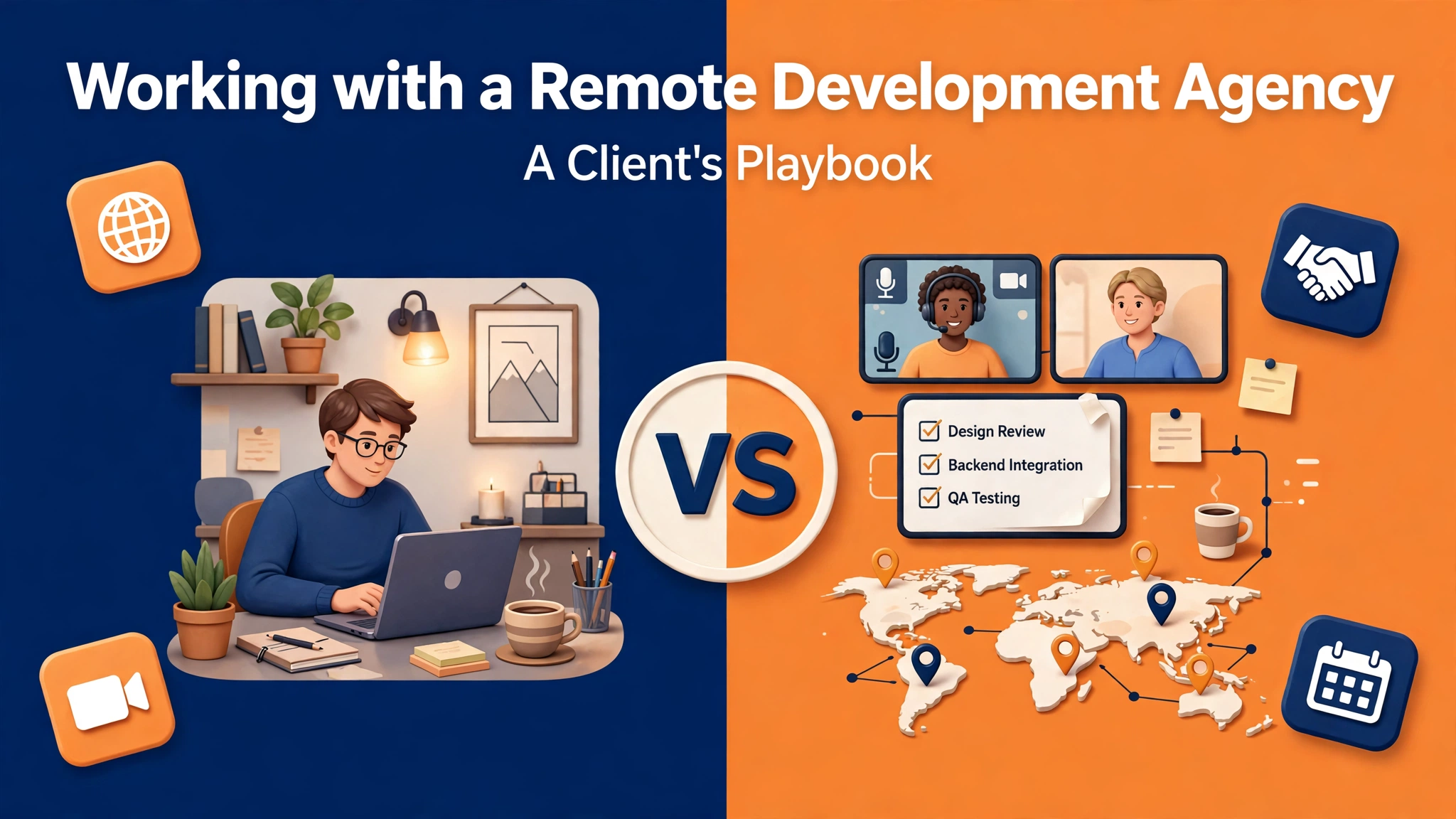
Hiring a remote development agency feels different from hiring a local one, and the difference is not the distance. It is the fact that you cannot walk into their office, look at the team, and get a feel for how they work. Everything you would normally judge in person has to be judged through calls, documents, and the way they handle the first few weeks. This playbook covers how to do that well.
Whether you are a founder in London, a clinic owner in Dubai, or a retailer in Amsterdam looking for a team to build your app or website, the same questions apply. The answers just matter more when the team is in another country.
The usual reasons are cost, speed, and access to skills. A remote agency in a different market can often field a senior team faster than a local hire, and at a rate that fits a smaller budget. But the best reason is focus. A good remote agency does one thing all day, every day: build software for clients. That repetition shows up in the process, the questions they ask, and the mistakes they no longer make.
The wrong reason is price alone. The cheapest remote team is usually cheap because something is missing: senior oversight, testing, documentation, or the willingness to push back when a request does not make sense. A low quote that skips those things is not a bargain. It is a delayed bill.
A remote engagement lives or dies on clarity. Before you sign anything, check these five things.
Ask directly: who owns the code, the designs, the accounts, and the data? The answer should be you, in writing, from day one. That includes the source code repository, the app store accounts, the hosting, and the domain. An agency that keeps the code in its own private account and hands it over “at the end” is keeping leverage over you. Walk away from that arrangement, politely but firmly.
Ask also what happens if the relationship ends. A professional agency will have a clear answer: handover documentation, access transfer, and a defined exit. If the answer is vague, take that as your answer.
Agency websites show senior people. Projects are sometimes staffed by juniors. Both can be fine, but you should know which you are getting. Ask who will be on your project, what their experience is, and who reviews their work. A senior engineer reviewing every change is worth more than one whose name is on the proposal but never appears again.
Time zones are a feature, not a problem, if they are handled honestly. A team in Lahore working with a client in London has a comfortable overlap in the afternoon. Ask for the overlap hours in writing, and ask what happens when something urgent comes up outside them.
More important than hours is rhythm. A weekly demo of working software is the single best habit. A short written update with what shipped, what is next, and what is blocked is the second. If the agency’s plan is “we will update you when there is something to report,” you will spend the engagement wondering.
There are two honest models: fixed price and time and materials. Fixed price works when the scope is clear and unlikely to move. Time and materials works when the scope will evolve. Either is fine. What is not fine is a quote with no breakdown, or a fixed price that quietly excludes testing, deployment, and the first month of fixes.
Ask what the quote covers, what it excludes, and how changes are priced. The answers tell you more about the agency than the price does.
References are useful, but only if you ask the right questions. Do not ask whether the client was happy. Ask what went wrong, how the agency handled it, and whether the client would hire them again. Ask to speak to a client whose project was similar in size to yours. A good agency will connect you without hesitation.
The first fortnight sets the pattern for the whole engagement. In the first few days, the agency should ask questions that show they have read your brief properly: about your customers, your current system, and what success looks like in six months. If the questions are only about colours and buttons, they are building a surface, not a product.
By the end of week one, you should have a plan you can read and argue with: the phases, the milestones, the decisions you need to make, and the dates. It needs to be specific enough that you can tell whether it is slipping.
By the end of week two, you should have seen something real: working software on a link, or a concrete technical decision with reasons. Agencies that demo early find problems early, when they are cheap to fix. Agencies that go quiet for a month and return with a finished product are the ones that deliver surprises.
Remote rates vary widely by market, and a rate that looks low in London may be a strong senior rate in Lahore or Cairo. Judge the rate against the team you are getting, not against local salaries.
Watch for the costs that hide outside the quote. App store fees, hosting, third-party services, and ongoing maintenance are usually separate. Maintenance deserves its own line: a live product needs updates, monitoring, and fixes, and the agency that built it is usually the best team to provide them. Agree the maintenance arrangement before launch, not after something breaks.
Be cautious of a quote that is dramatically lower than the others. More often than not it means the scope was understood differently, or the testing was left out. Ask the low bidder to walk through the quote line by line.
Watch for an agency that agrees with everything you say and never pushes back; a proposal that could have been written for any client, with your name pasted in; no questions about your business, only about features; a refusal to give you access to the code repository; and a team that goes quiet for days without explanation.
None of these is proof of a bad agency. Together, they are a pattern. Trust the pattern over the sales call.
A remote engagement is a partnership, and your side of it matters too. Three habits make the biggest difference.
First, give one decision-maker on your side. A team that waits for a committee will stall. Second, answer promptly. A question that waits three days costs three days. Third, treat the demo as sacred. Show up, try the software, and give honest feedback. The demo is where the product gets better and misunderstandings surface while they are still cheap.
Finally, remember that good agencies tell you things you do not want to hear: that a feature will cost more than it is worth, that a deadline is unrealistic, that the data you have is not ready. That friction is the service. An agency that only agrees with you is not protecting your investment.
Check the basics: a real company with a real address, a website with real work, clients you can speak to, and a contract that names ownership, payment terms, and exit conditions. Then check whether they ask good questions about your business before talking about technology.
They should overlap with you for a few hours a day, enough for a call and quick answers. What matters is that the overlap is agreed, kept, and used well.
This is why ownership and access matter. If you own the code and the accounts, you can change teams without starting over. Raise problems early, in writing, with specific examples. A professional agency will propose a fix, a revised plan, or a clean handover.
Often yes. Small projects are where remote teams are most efficient. The key is the same as for a large project: clear scope, clear ownership, and a team that demos early.
The best remote engagements start with a conversation, not a quote. Talk to two or three agencies, ask them the questions in this playbook, and compare how they answer, not just what they charge. The agency that asks the best questions about your business is usually the one that builds the best product.
If you would like to talk to us, book a free strategy call. We will ask about your project and tell you plainly whether a remote team is the right fit. We aim to reply within 24 hours, and you leave the call with a plan whether or not you work with us.
For a related read, see Hiring a Software Agency in the UK: What to Ask Before You Sign.
More from the studio.
Planning to hire a software agency in the UK? The questions to ask before you sign, covering pricing, ownership, process and support, so you choose well.
Talha Javed7 min readHow our app development process works, from the first kickoff call to App Store launch: phases, handoffs, and habits that keep a build on schedule and budget.
Talha Javed7 min readMost apps should be built once in Flutter. Some should not. Here is the short checklist we run through with every client before writing a line of code.
Talha Javed2 min readA free 30-minute call with a senior engineer. You leave with a plan and a price range, whether or not you hire us.