Software Development in Dubai: How to Choose the Right Agency
Software development in Dubai: how to choose the right agency partner, from pricing and contracts to portfolios, so you sign with confidence.
 Talha Javed7 min read
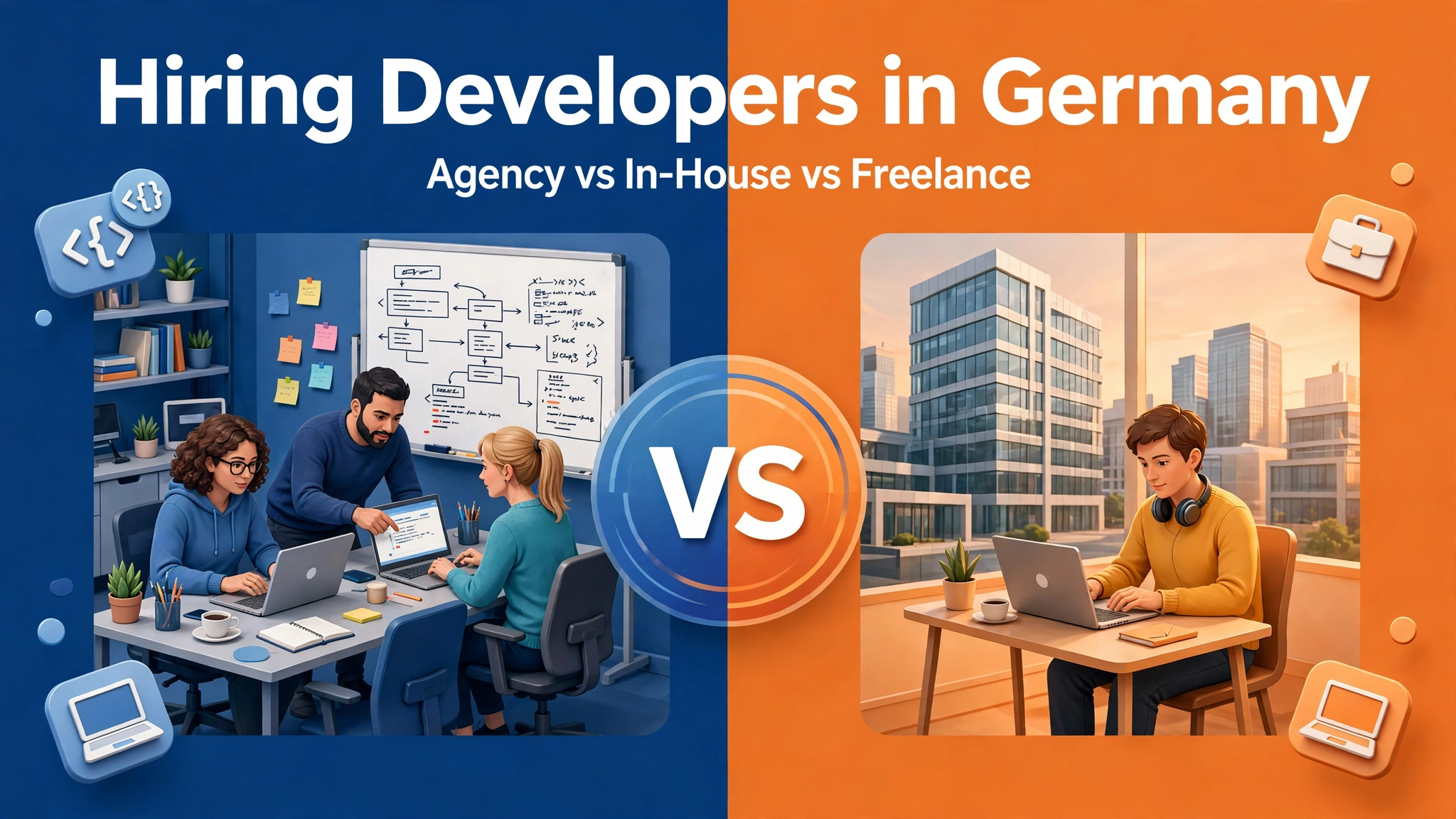
You need developers in Germany and you need them soon. A product idea is waiting, a deadline is set, or an existing system needs work, and the first decision is who builds it. Hiring developers in Germany gives you three realistic routes: in-house, an agency, or freelancers. Each one changes what the project costs, how fast it starts, and who carries the risk. Picking the wrong route is how good projects lose months before a line of code ships.
The three routes look similar from the outside and behave very differently in practice. This guide compares them on cost, speed, control, and what happens after launch.
An in-house developer becomes your employee. You hire them, you manage them, and they work on your product full time. An agency gives you a team for a defined project, developers plus design, testing, and project management, under one contract. A freelancer is an individual you engage for a set piece of work.
None of them is right for everyone. The right answer depends on how long the work lasts, how much management you can do yourself, and how much risk you can carry.
Hiring in-house means building your own team. You run interviews and sign an employment contract under German law. That contract brings obligations with it: social contributions, holiday entitlement, notice periods, and the admin of employing someone in Germany. These are normal parts of hiring here, but they add cost and time beyond the salary itself.
The strength of an in-house team is continuity. Developers who stay with a product for years build knowledge that no outside team can match. They know why a decision was made two years ago. For a core product that will be developed for years, this is hard to beat.
The weakness is speed and flexibility. Recruitment takes time, and in Germany notice periods can stretch to months, so the developer you want may not be free to start when you need them. A bad hire is expensive to undo, and you need someone technical inside the company to manage the team well.
In-house hiring fits best when the product is the business and the roadmap runs for years.
An agency gives you a whole team under one contract: developers, a designer, someone testing the work, and a project manager keeping it on schedule. You agree on scope and a price, and the agency is responsible for delivering it. The developers are the agency’s employees, so German employment admin stays with the agency.
The strength of an agency is that you start with a complete team instead of building one person by person. You also get a second opinion built in: a good agency will tell you when a feature is not worth building, because their reputation depends on the result, not on the hours billed.
The weakness is that you need to choose well. Agencies vary widely in quality, and the cheapest quote is rarely the best value. Before you sign, ask who will actually work on your project and how often you will hear from them. Our guide to hiring a software agency, and the questions to ask before you sign, covers the questions that matter most, and they apply in Germany just as they do in the UK.
A freelancer is the fastest route to an extra pair of hands. You find someone with the exact skill you need, agree on a rate and a scope, and they start. For a small, well defined piece of work, this is often the simplest option. A freelancer can also be the right call when you need a specialist for a few weeks.
The trade off is that you become the manager. You coordinate the work, check the quality, and hold the knowledge of how the pieces fit together. When the engagement ends, the knowledge leaves with the freelancer unless you insisted on documentation. Availability is the other risk. A good freelancer may be booked for months.
Comparing the three routes by headline price alone is misleading.
An in-house developer costs a salary plus employer contributions, recruitment, equipment, and the time it takes a new hire to become productive. The monthly cost looks stable, but the total is higher than the salary line suggests. In our experience, companies that budget only for salary are surprised by the rest.
An agency charges a project fee or a monthly retainer. That fee includes the team, their management, and their tools. It looks higher than a single salary, but it replaces recruitment, management, and the cost of a hire that does not work out. For a project of a few months, the agency route often costs less in total than hiring.
A freelancer charges by the day or by the hour. The rate looks low next to an agency fee, until you add your own time spent managing, reviewing, and coordinating. If you have that time and the skill to judge the work, a freelancer can be the cheapest route.
Compare the whole route, not the headline number: salary plus contributions for in-house, fee plus your time for an agency, rate plus your time for a freelancer.
A freelancer can often start within days if they are available, which makes freelancers the fastest option when timing is tight. The catch is availability: the best freelancers are usually booked.
An agency can usually start within a couple of weeks of agreeing scope, because the team already exists. The work before kickoff is agreeing what gets built, which is time well spent.
In-house is the slowest route to a first working day. Recruitment takes time, and notice periods in Germany can run to several months. If you need developers next month, in-house hiring alone will not get you there. Many companies start with an agency or freelancers while they recruit.
If you are building an MVP with a deadline and a fixed budget, an agency is usually the best fit. You get a team, a price, and a date. If you are building a product your company will run for years, hire in-house, and start with an agency so the product exists while you recruit. If you need a small, well defined piece of work done quickly, a freelancer is the simplest answer. If you work in a regulated industry, an agency or an in-house team is usually safer, because contracts, documentation, and data handling are easier to control.
A hybrid is common and often the smartest choice. An agency builds the first version, your in-house team takes it over, and freelancers fill specialist gaps along the way. Our guide to working with a remote development agency explains how to run that handover without losing momentum.
Whichever route you choose, a few things should be settled in writing before work starts.
First, intellectual property. The contract should say clearly that you own the code, the designs, and the documentation, and that they are handed over in full. Second, documentation. Ask how knowledge is recorded so the project survives someone leaving. Third, communication. Agree on how often you hear from the team and who your point of contact is. Fourth, data protection. Under GDPR, you need to know where personal data is processed and who is responsible for it. Fifth, references. Ask for similar projects and speak to at least one past client before you commit.
These checks take a few hours and save months. The companies that skip them are the ones that call us later to rescue a project with no documentation and no code ownership.
Yes. You can employ people in Germany directly, work with a German agency, or engage freelancers. Each route has different admin and tax implications, so get local advice before you choose.
Most developers in Germany work in English day to day. Contracts and official paperwork are often in German, so having someone who reads German makes the process smoother.
It depends on the timeframe. For a project of a few months, an agency is often cheaper in total once you count recruitment, employer contributions, and the time to hire. For work that runs for years, an in-house team usually costs less per month.
Look at similar work they have shipped, speak to a past client, and start with a small paid piece of work before committing to a large project. Make sure the contract covers code ownership and documentation.
This is a decision about your product’s next two years, not just its next two months. The route that fits depends on your timeline, your budget, and how much management you can do yourself. If you are weighing these options and want a second opinion, book a free strategy call. Tell us what you are building and when it needs to ship, and we will talk through which route fits. We reply within 24 hours.
More from the studio.
Software development in Dubai: how to choose the right agency partner, from pricing and contracts to portfolios, so you sign with confidence.
Talha Javed7 min readHiring a remote development agency? How to check ownership, process and communication before you sign, and how the first weeks should run.
Talha Javed7 min readPlanning to hire a software agency in the UK? The questions to ask before you sign, covering pricing, ownership, process and support, so you choose well.
Talha Javed7 min readA free 30-minute call with a senior engineer. You leave with a plan and a price range, whether or not you hire us.