Choosing a Tech Stack for Your SaaS in 2026
Choosing a SaaS tech stack in 2026? A founder's guide to frontend, backend, database and hosting choices that keep costs low and your product easy to scale.
 Talha Javed7 min read
Clients spend a lot of time choosing between Flutter and native, and almost none asking a question that changes the architecture far more: what should the app do when there is no signal?
For a consumer app used on sofas, the answer is “show a spinner”. For a field sales app, a badge scanner at a trade show, a workshop tracker or a delivery app, the answer decides whether the product works at all.
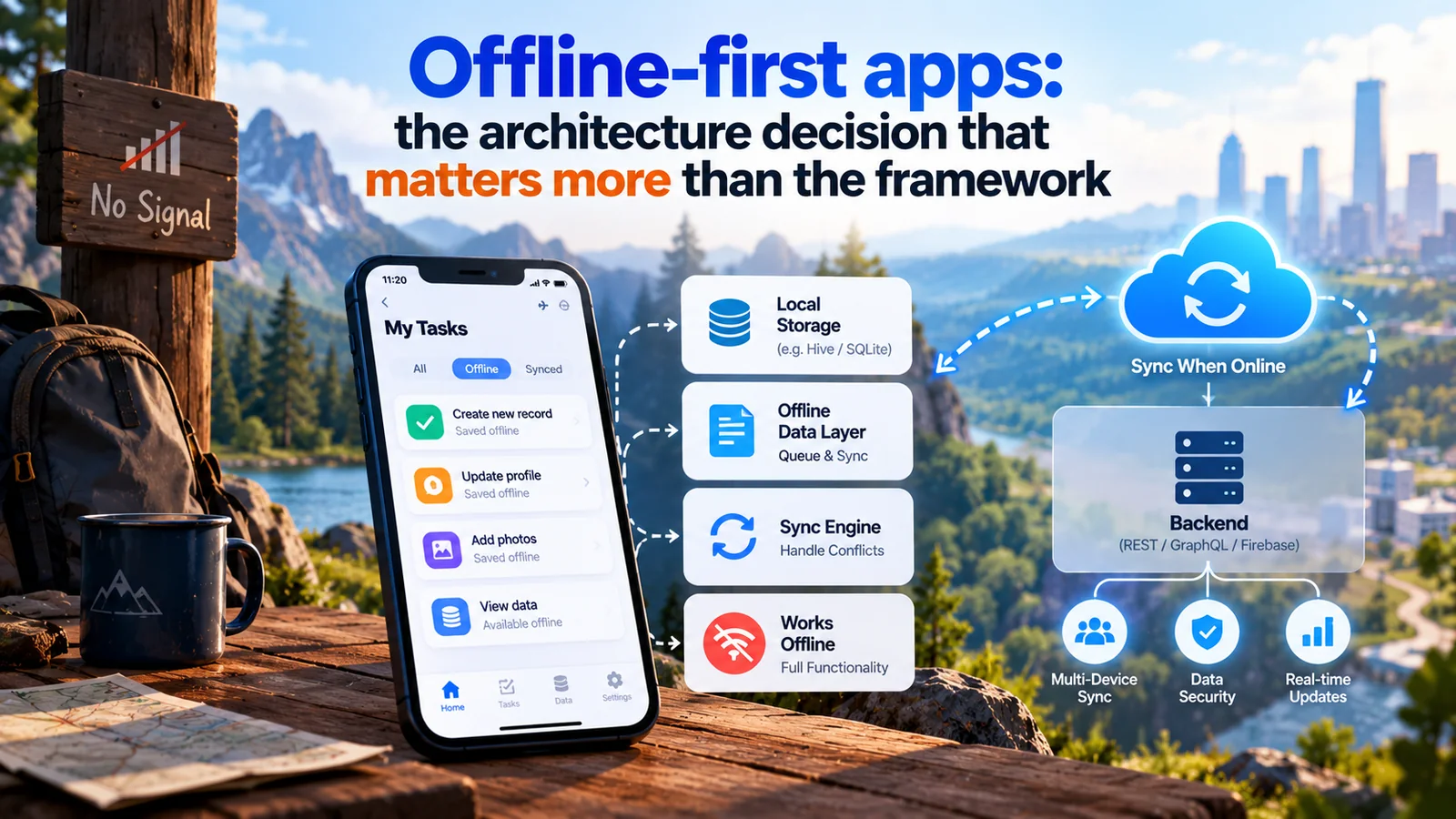
It does not mean “cache the last screen”. It means the app is designed so that the device is the primary place where work happens, and the server is where that work is synchronised to when a connection exists. Concretely:
An online-only app is a thin skin over an API. An offline-first app has a local database, a sync engine, and a server that can accept changes out of order and resolve them. Adding that to an existing app means rewriting most of the data layer — in our experience, it costs more than building it that way from the start would have.
The reverse is cheap. An offline-first app works beautifully online; it is simply faster.
The backend needs to think in terms of changes rather than snapshots: accept a batch of operations with timestamps, apply them in order, detect conflicts, and tell the client what the resolved state is. Identifiers are generated on the device, not by the database, so records can be created without asking the server for an ID. None of this is exotic, but it is different, and it is far easier when the API is designed for it than bolted on.
If you are in the first list, say so in the first conversation. It is the single most useful sentence a client can put in a brief, and it changes the plan we come back with.
More from the studio.
Choosing a SaaS tech stack in 2026? A founder's guide to frontend, backend, database and hosting choices that keep costs low and your product easy to scale.
Talha Javed7 min readAPI design best practices we follow on every project: versioning, errors, auth, and docs that keep integrations working for years.
Talha Javed7 min readSupabase vs Firebase compared for startups in 2026: pricing, auth, database, realtime and lock-in, so you pick the backend your product can grow with.
Talha Javed7 min readA free 30-minute call with a senior engineer. You leave with a plan and a price range, whether or not you hire us.