API Design Best Practices We Follow on Every Project
API design best practices we follow on every project: versioning, errors, auth, and docs that keep integrations working for years.
 Talha Javed7 min read
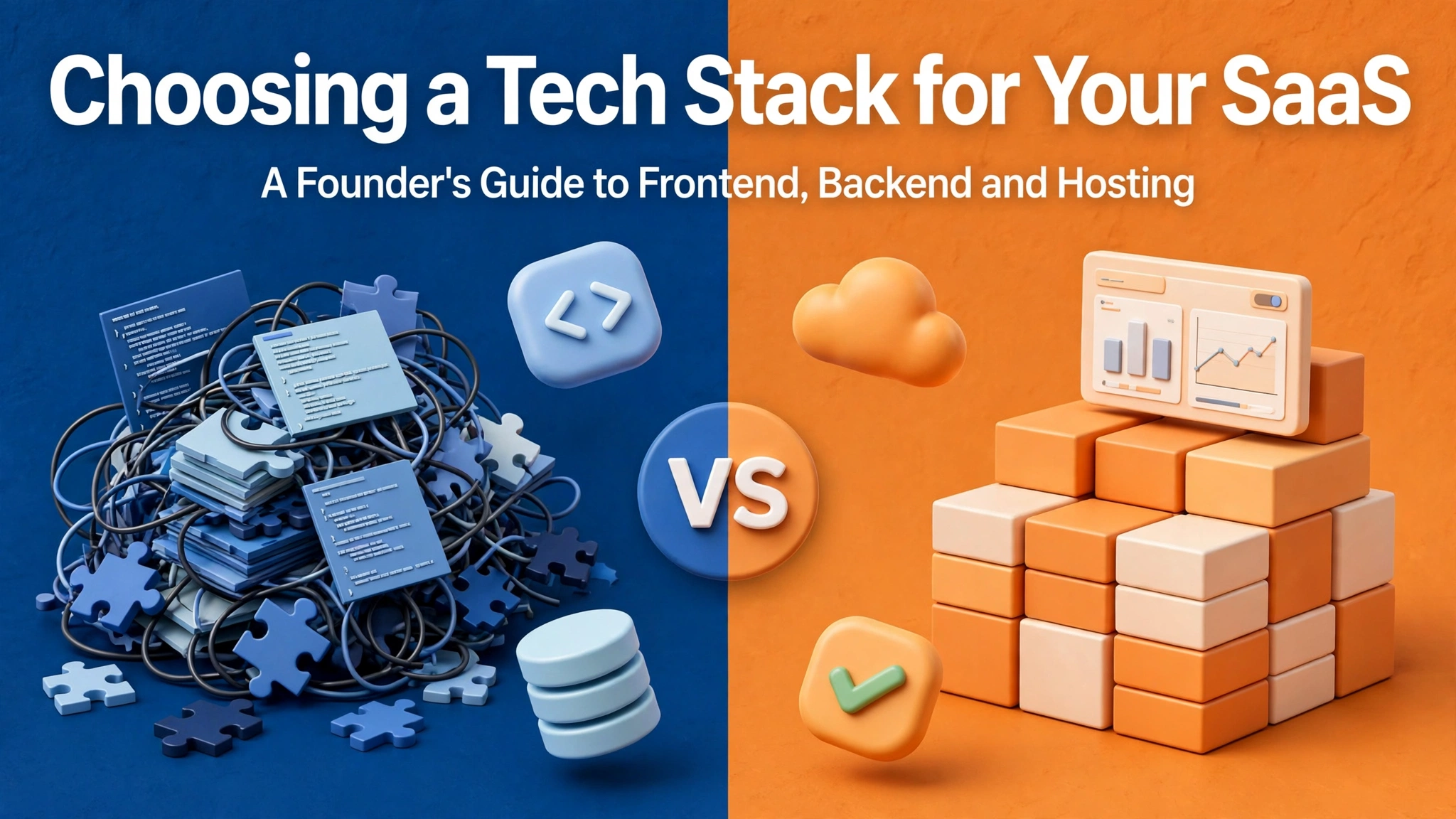
You have a SaaS idea, a budget, and a deadline. The first question everyone asks is which tech stack to use, and the answers you get online will not help much. Every framework has fans who insist it is the only sane choice, and every comparison article ends with “it depends” and no decision at all.
There is no perfect stack, only a stack that fits your product and your team. A wrong choice rarely kills a product on day one. It kills it slowly, through hiring pain, slow feature delivery, and a hosting bill that grows faster than your revenue.
Before you compare frameworks, write down what the product actually does. A billing dashboard for accountants has almost nothing in common with a real-time collaboration tool, even though both are SaaS. The first needs forms, tables, and rock-solid data. The second needs live updates and shared editing. The stack that makes one easy makes the other painful.
Ask four questions and write the answers down.
What does a user do in the first five minutes? If the answer is mostly reading, searching, and filling in forms, almost any modern stack will do. If it involves live cursors or streaming data, you need real-time capability from the start.
How much data does each customer generate? A few hundred records a month is a different problem from millions of events a day.
Who builds and maintains it? A stack your team already knows beats a fashionable one they have to learn under deadline. In our experience, founders who pick a stack with a large hiring pool in their market ship faster and replace people more easily.
If you cannot answer these questions yet, that is the work to do first. No framework choice fixes a fuzzy product.
For most SaaS products, the frontend choice comes down to two families: a web framework like React or Next.js, or a cross-platform framework like Flutter Web.
Next.js is the default choice for a SaaS web app. It handles server rendering, which helps search engines find your marketing pages and your app. It has a huge ecosystem, so the chart library, the table component, and the payment integration you need already exist. If your product is a dashboard or a settings-heavy admin tool, this is the safe pick.
Flutter Web is worth considering when the product also needs mobile apps. One codebase shipping to web, iOS, and Android saves real money for a small team. The trade-off is SEO. Search engines still struggle with Flutter Web pages compared with server-rendered HTML, so marketing pages usually need a separate site anyway. If the web app needs to rank on Google, pick a web-first framework.
Do not choose a frontend for its demo. A framework that builds a beautiful landing page in an afternoon can still make a complex data table miserable. Ask your developer to build one real screen from your product, the densest one, with real data, before you commit.
The backend is where founders overthink the most and where the choice matters least in the early days. For a typical SaaS product, a single well-built backend in Node.js, Python, or Go will carry you a long way. The language matters far less than the discipline of the team writing it.
What matters more is the shape of the system. Our guide to monolith vs microservices covers this in detail, but the short version is simple. Start with one codebase. Split it when a specific part genuinely needs to scale or deploy on its own, not before. Microservices solve scaling problems. They also create deployment, debugging, and hiring problems, and a young product rarely has the scaling problem yet.
The database choice deserves more care, because it is harder to change later. PostgreSQL is the default we recommend for most SaaS products. It handles relational data, full-text search, and JSON fields in one place, and it scales further than most products ever need. Managed backends like Supabase and Firebase can speed up the first version a lot, though pricing grows with usage, as our comparison of Supabase vs Firebase explains. Plan the exit before you need it: know how you would export your data and move it elsewhere.
For the first version, a platform that handles deployment for you is usually the right call. Services like Vercel, Railway, or Render let a small team ship without hiring a DevOps engineer. You pay a premium for the convenience, and in the early days that premium is cheap compared with an engineer’s salary.
The hosting costs that surprise founders are the quiet ones. File storage, image processing, email delivery, and background jobs each have their own pricing, and each grows with your user count. Ask your developer for a rough monthly cost at a hundred users and at ten thousand users before you launch.
One more practical point: keep your data in a region your customers care about. If your customers are in the UK and Europe, a European region keeps response times low and makes GDPR compliance simpler. If your customers are in the UAE and Saudi Arabia, a Gulf region does the same for them.
Founders usually compare stacks by build cost. The real comparison is total cost over the first two years, and it has four parts.
The build cost is the smallest part. Most stacks can build a first version in similar time when the team knows them well.
The hiring cost is where stacks diverge. A niche stack means fewer candidates, longer hiring, and higher salaries. A mainstream stack means a bigger pool and more people who can review each other’s work.
The maintenance cost is the quiet one. Dependencies need updates, frameworks release breaking changes, and security patches cannot wait. A stack with a large community and a stable release cycle costs less to keep healthy than one that reinvents itself every year.
The scaling cost is the last one, and it is mostly about the database and the architecture, not the language. A product that stores data badly will pay for it no matter what framework sits on top.
When a vendor tells you a stack is cheaper, ask which of these four costs they mean.
The first mistake is picking a stack to impress other developers. Your customers never see your stack. They see whether the product works, loads fast, and does what you promised. A boring, proven stack that ships is worth more than an exciting one that stalls.
The second mistake is splitting the product too early. Separate services for billing, notifications, and search feel professional. They also mean three deployments, three places to look when something breaks, and three systems to keep updated. One codebase with clear internal boundaries is the right start for almost every SaaS product.
The third mistake is ignoring the exit. Every managed service has a price at which it stops making sense. Before you commit, know how you would leave: can you export your data, can you move your hosting, and how much code would you rewrite? If the answer is “we would start over”, the lock-in is too tight.
List the three hardest things your product has to do well, the things that would make it fail if they were slow or broken. For most SaaS products that list includes search, billing, and one feature unique to the product. Choose the stack that makes those three things easy, and ignore the rest.
Then ask who will build it, who will maintain it in a year, and what it costs at a thousand paying customers. If the same stack wins on all three answers, you have your decision. If different stacks win different questions, weight the maintenance and hiring answers more heavily than the build answer.
It depends on where your users are. If the web app is the product and SEO matters, React with Next.js is the safer choice. If you need web, iOS, and Android from one small team and the web app is mostly behind a login, Flutter is a strong option.
Yes, for getting the first version out quickly. Auth, database, and storage come ready-made, which saves weeks of work. Check pricing at scale before committing, and know how you would export your data if you ever moved away.
You cannot know for certain, and you do not need to. Check whether the database can handle your expected data volume, whether the hosting can add capacity without a rewrite, and whether the system can be split into parts later. Those three checks cover most scaling problems a SaaS product meets in its first years.
Choosing a tech stack is a decision you will live with for years, and it is cheaper to get it right than to fix it later. If you are weighing options for a SaaS product, book a free strategy call and tell us what the product does and who will build it. We will give you an honest view on the stack, the cost, and the timeline, and we reply within 24 hours.
More from the studio.
API design best practices we follow on every project: versioning, errors, auth, and docs that keep integrations working for years.
Talha Javed7 min readSupabase vs Firebase compared for startups in 2026: pricing, auth, database, realtime and lock-in, so you pick the backend your product can grow with.
Talha Javed7 min readMonolith vs microservices for founders: when one codebase wins, when splitting pays off, and the questions that settle the choice.
Talha Javed7 min readA free 30-minute call with a senior engineer. You leave with a plan and a price range, whether or not you hire us.